
Thoughtful explorations of architecture, design, art, culture, and the quiet details that shape contemporary life. Each MéMOIRES invites you to look closer and consider not only what we see, but why it matters. Published on jeudis (Thursdays), each edition becomes part of a continuing repository.
Éicìéi
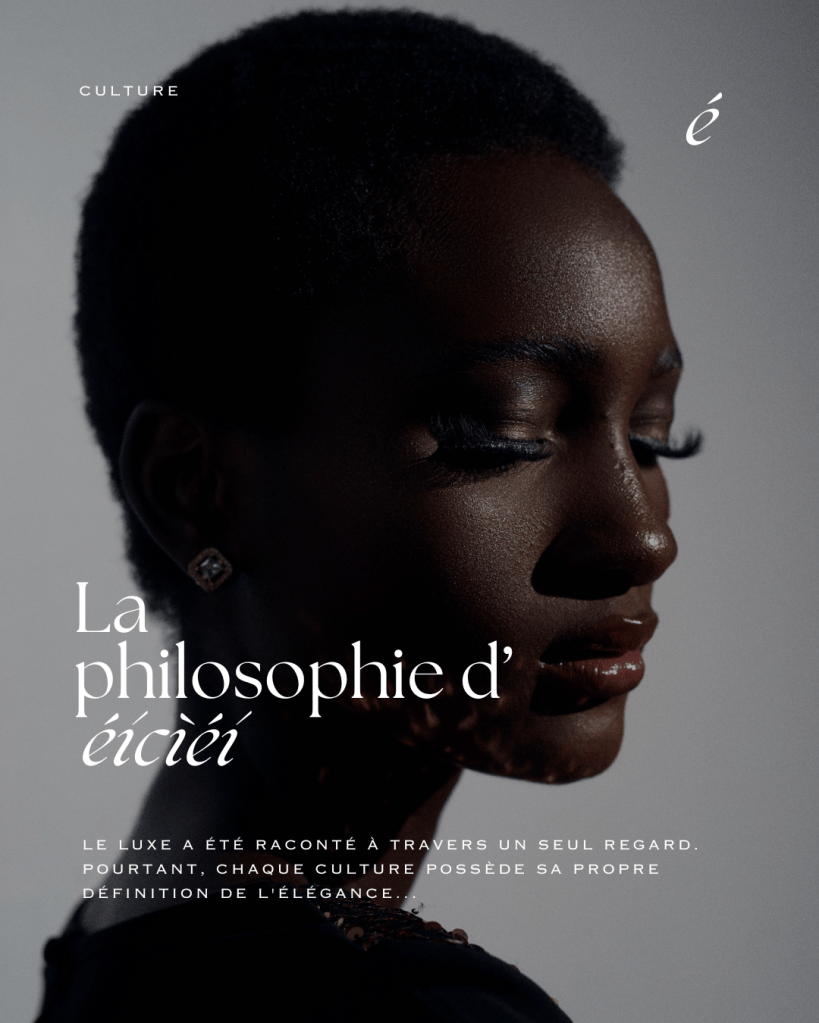
Éicìéi is the founder’s mémoires. She looks toward Africa and its extraordinary inheritance of literature, architecture, philosophy, fashion, craftsmanship, and traditions of refinement.
Written in both French and English, she seeks what deserves to be remembered, celebrated, and carried forward.
The archive
COPY-PASTE COUTURE: WHY EVERY FASHION BRAND SUDDENLY LOOKS THE SAME
If your feed, the boutique windows on your street, and every glossy magazine cover have started blurring into one long déjà vu, you’re not losing it. BY DAYANA KAZANGAPOVA Fashion and branding are in the middle of a real identity crisis. Experimentation, archival depth, and aesthetic personality have been flattened into a single house style.…

VENICE FILM FESTIVAL AND THE RE-WEARING CULT
Sustainable fashion, reconsidered: what the Venice Film Festival’s red carpet reveals about re-wearing. BY CHIARA DI LEO In recent days, Venice hosted one of the world’s most important festivals: the Venice Film Festival: the Venice Film Festival. During this special event, many films are presented, and directors are rewarded, but that’s not the only thing…
“SOUTH SUDAN’S ANGELS: THE COST BEHIND THE LOOK”
“Ebony skin, long limbs, angelic face: these are the dehumanised models.” BY CHRISTINE AMEFIAM South Sudanese people are the most sought-after models at the moment; what makes them stand out is their dark skin, features and long limbs. Some of the most famous models include Nyakim Gatwech, Anok Yai, and Adut Akech. Let’s hear about…
ACCESS DENIED IF NOT ELEGANT ENOUGH
JEUDI éCHOS x UMA SOCIETY The way we dress, for some races, can be just as important as what we are saying. For many people, a simple white T-shirt, a pair of jeans and sneakers can be enough to grant them access to almost any space they want to enter. For others, even when dressed…
EQUATOR ECHOES MAGAZINE
INTERVIEW WITH ALESSIA D’INTRONO What inspired the creation of Equator Echoes Magazine? The art magazine Equator Echoes was born during my university studies and developed over five years of continuous independent research. Its creation was gradual: there wasn’t a single source of inspiration, but if I had to think of one particular event, I would…
“AFRICAN” WAX: A COMPLEX PARADOX
BY LUIGINA D’INTRONO The twisted truth about one of Africa’s identities. For decades, colourful wax print fabrics have been proudly worn across Africa and the diaspora as the quintessential symbol of African identity and fashion. From everyday household wear to high-fashion runways, wax prints, also known as Ankara, Kitenge, or Kanga, are seen as the…
JOHN GALLIANO’S CONTROVERSY AND THE MET GALA:
BY CHIARA DI LEO Can we separate the artist from the art? How many artists do we know are controversial? Take Pablo Picasso, for example, or in late 2022, the controversy surrounding the designer Demna, who came under fire after Balenciaga released a campaign under his tenure featuring children holding teddy bears in BDSM-style gear.…
WHEN CULTURE BECOMES A TREND
BY GIULIA LIU Everyone has probably seen Adidas’ Tang Suit at least once: a jacket that combines the classic design of an Adidas tracksuit with elements inspired by traditional Chinese clothing, particularly the tángzhuāng. The jacket was officially presented during Shanghai Fashion Week towards the end of 2025 as a piece dedicated to Chinese Lunar…
THE MET GALA’S SYNOPSIS
BY CHIARA DI LEO For those who might need a quick catch-up, here is a summary of what you need to know about this iconic event and its most recent edition. Once a year, New York City becomes the centre of the fashion world as all eyes lock onto a single event: the Met Gala.…
About the writers
Jeudi Échos is shaped by a collection of distinct voices, perspectives, and disciplines.
Our writers explore the ideas, objects, places, and questions that define contemporary life, each bringing their own way of seeing, questioning, and reflecting. Some write to observe; others to question, interpret, or provoke. Together, their voices form the evolving editorial character of Jeudi Échos.

Chiara Di Leo is a cultural professional and writer whose work sits at the intersection of culture, art, and contemporary life. She graduated with honours, 110 e lode, from Università Cattolica del Sacro Cuore, where she studied Economics and Management of Cultural and Performing Arts.
Her professional experience includes Triennale Milano, one of Italy’s most prestigious institutions dedicated to contemporary culture, design, and the arts, where she developed a close understanding of the cultural world and its institutions. She has also contributed to TEDxUNICATT as an event operator, further cultivating her experience in communication, cultural exchange, and the organisation of ideas in public spaces.
At Jeudi Échos, Chiara brings an attentive and intellectually curious perspective to culture and the arts, exploring the ideas, people, and expressions that give contemporary life its meaning. Her approach is grounded in the belief that culture is not merely something to observe, but something to understand, question, and experience.

Giulia Liu is a content creator and social media manager whose work brings together culture, communication, and contemporary media. She graduated from the Università degli Studi di Milano in Linguistic and Cultural Mediation, developing a particular sensitivity to language, intercultural dialogue, and the ways in which ideas move between cultures.
Her professional experience includes Triennale Milano, where she gained insight into contemporary culture, art, and design within one of Italy’s most distinguished cultural institutions. Her experience in digital communication and social media further informs her ability to translate cultural narratives into engaging visual and editorial experiences.
Multilingual by nature, she speaks Italian, French, English, Chinese, and Japanese, bringing a distinctly international perspective to her work. At Jeudi Échos, she brings together language, culture, and digital storytelling, contributing to the publication’s visual identity and its dialogue with an increasingly global audience.
Dayana Kazangapova is an architect, concept developer, and multidisciplinary designer whose practice moves between space, image, and digital experience. She graduated in Architecture from Politecnico di Milano, developing an approach to design that extends beyond the built environment and into visual culture, identity, and digital expression.
Her experience includes working at Triennale Milano, one of Italy’s most distinguished institutions for contemporary culture, art, and design. Her practice encompasses spatial and visual design, concept development, web design, and graphic design, allowing her to approach projects as complete visual and experiential worlds.
Multilingual and internationally oriented, Dayana speaks Russian, Italian, English, Ukrainian, Polish, Kazakh, and Turkish, bringing a broad cultural perspective to her work and an intuitive understanding of different visual and cultural languages.
At Jeudi Échos, Dayana is one of the designers behind the publication’s visual identity and digital experience. From its visual language to its digital environment, she helps translate the principles of Order, Clarity, and Elegance into a coherent and tangible world.
For Jeudi Échos, design is not decoration. It is architecture for ideas.
