order, clarity, and elegance

JEUDI éCHOS

Magazine

2023—2026

“The essence of adornment”

spatial design, fine art, sartorial elegance & cultural legacy

The latest articles

  • L’Afrique, un potentiel à redécouvrir : Excellencia Mabe sur l’investissement et la diaspora


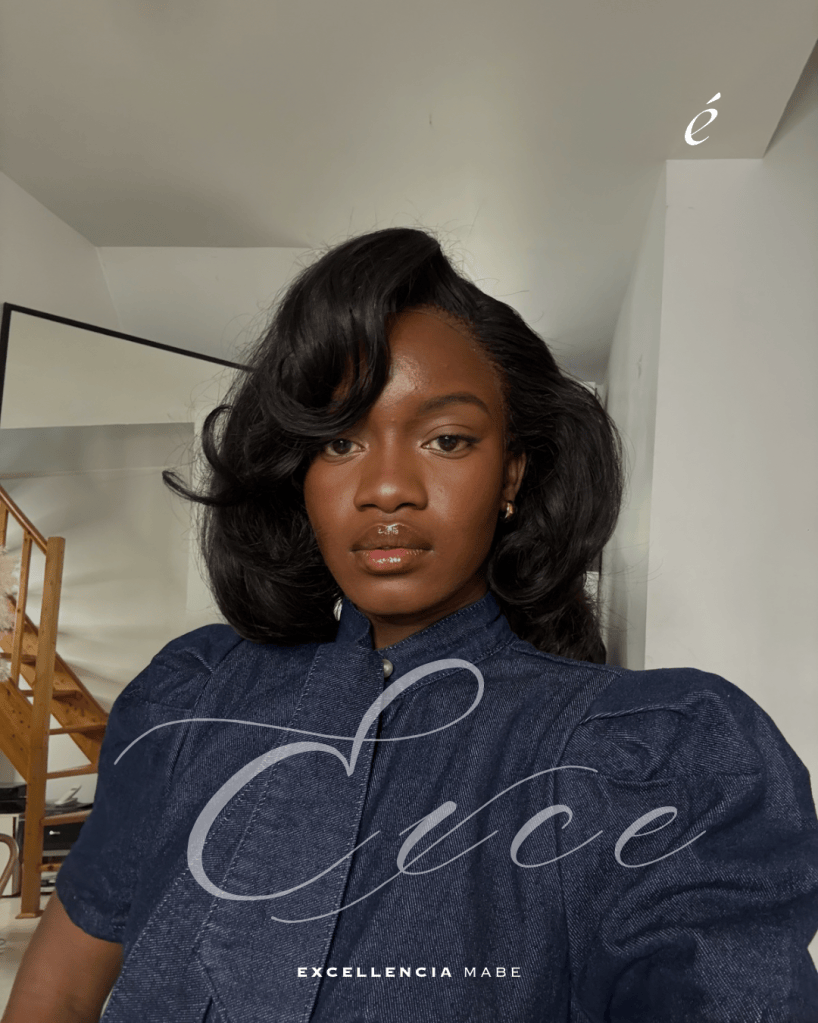
    INTERVIEW avec EXCELLENCIA MABE
    Entre potentiel économique, défis de confiance et rôle de la diaspora, l’entrepreneure centrafricaine invite les Africains à porter un nouveau regard sur leur continent et à prendre part à son développement.

    L’Afrique est souvent évoquée à travers les défis auxquels elle fait face. Pourtant, une autre réalité mérite tout autant d’attention : celle d’un continent aux économies diverses, riche en ressources, en talents et en possibilités entrepreneuriales encore insuffisamment exploitées.

    Pour Excellencia Mabe, influenceuse, entrepreneure et directrice générale d’une boîte de communication en marketing digital en République centrafricaine (RCA), la question n’est pas simplement de savoir si l’Afrique possède un potentiel économique. Il s’agit aussi de comprendre pourquoi ce potentiel reste parfois méconnu et comment les Africains, sur le continent comme au sein de la diaspora, peuvent contribuer à le concrétiser.

    Investir dans son pays d’origine peut prendre plusieurs formes. Il peut s’agir de créer une entreprise, de soutenir un projet local, de partager des compétences acquises à l’étranger ou de nouer des partenariats permettant de développer de nouvelles activités. Au-delà du capital financier, la diaspora peut ainsi apporter des connaissances, une expérience professionnelle et des réseaux internationaux précieux.

    Mais cette démarche n’est pas toujours évidente. Le manque de confiance, les difficultés d’accès au financement, les incertitudes économiques et la crainte de perdre son argent peuvent freiner les initiatives les plus prometteuses.

    Pour Mabe, ces obstacles ne devraient toutefois pas empêcher les Africains d’envisager les possibilités qui existent sur leur continent.

    La confiance, une condition essentielle de l’investissement

    L’un des freins à l’investissement de la diaspora réside, selon Excellencia Mabe, dans le manque de confiance envers certaines structures censées faciliter ces investissements.

    Les personnes qui souhaitent investir ont besoin d’informations claires, de procédures compréhensibles et de garanties adaptées lorsqu’elles sont possibles. Elles veulent également savoir comment leur argent sera utilisé et quels résultats les projets soutenus pourront produire.

    Lorsque les organisations chargées d’accompagner les investisseurs communiquent peu, manquent de transparence ou ne démontrent pas concrètement leur impact, il devient difficile de convaincre de nouveaux partenaires.

    Encourager la diaspora à investir ne suffit donc pas. Il faut aussi créer un environnement dans lequel les investisseurs peuvent prendre des décisions éclairées.

    La confiance se construit à travers la transparence, la responsabilité et la qualité des relations établies avec les acteurs locaux. Des partenaires présents sur le terrain peuvent notamment aider les investisseurs à mieux comprendre les réalités économiques, les démarches administratives et les besoins du marché.

    Investir en Afrique ne signifie pas pour autant prendre des risques sans discernement. Aucun investissement n’est totalement exempt de risques, quel que soit le pays concerné. L’enjeu consiste plutôt à évaluer les risques propres à chaque projet, à vérifier sa viabilité et à s’entourer de personnes capables d’en faciliter la réalisation.

    La République centrafricaine : un potentiel à explorer

    Excellencia Mabe estime que la République centrafricaine dispose d’opportunités encore insuffisamment explorées. Selon elle, certains secteurs laissent une place aux entrepreneurs capables de proposer des solutions adaptées aux réalités du pays.

    Une concurrence limitée peut parfois représenter une occasion de développer une activité. Elle ne constitue cependant pas, à elle seule, la preuve qu’un marché est rentable. Elle peut également refléter des difficultés plus profondes, telles que le manque d’infrastructures, l’accès limité au financement ou les incertitudes liées à l’environnement des affaires.

    Pour identifier les possibilités réelles, il est donc essentiel de considérer à la fois les besoins du marché et les conditions nécessaires à la réussite d’un projet.

    Les analyses économiques permettent de mieux cerner ces enjeux. La Banque mondiale a notamment souligné l’importance de l’approvisionnement en énergie, du développement de l’agro-industrie et de la promotion des services privés pour soutenir la croissance de la République centrafricaine. Elle a également mis en avant le potentiel de l’agriculture, des ressources naturelles et de l’écotourisme. Source : Banque mondiale.

    Ces secteurs peuvent ouvrir des perspectives, à condition que les projets tiennent compte des besoins locaux, des infrastructures disponibles et des contraintes opérationnelles. La transformation des produits agricoles, par exemple, pourrait contribuer à développer la production locale et à créer davantage de valeur sur place. L’accès à une électricité fiable et l’amélioration des services numériques pourraient également faciliter le développement des entreprises.

    Mabe évoque par ailleurs des initiatives et des partenariats à Bangui visant à mieux faire connaître le potentiel du pays, notamment un projet qu’elle désigne sous le nom de FIP. De telles initiatives peuvent contribuer à mettre en relation des porteurs de projets, des partenaires et des investisseurs. Leur portée dépend toutefois de leur capacité à instaurer la confiance, à communiquer clairement sur leurs objectifs et à obtenir des résultats concrets.

    L’enjeu est donc de dépasser les discours sur le potentiel pour identifier des projets réalistes, bien préparés et capables de répondre à une demande véritable.

    Quels secteurs attirent aujourd’hui les investissements en Afrique ?

    Le débat sur l’investissement ne concerne pas uniquement la République centrafricaine. À l’échelle du continent, plusieurs secteurs attirent l’attention des investisseurs, même si les opportunités diffèrent fortement d’un pays à l’autre.

    Selon ONU Commerce et Développement (CNUCED), l’Afrique a attiré environ 70 milliards de dollars d’investissements directs étrangers en 2025. Ce montant est inférieur au niveau exceptionnel enregistré en 2024, mais il demeure historiquement élevé. Les investissements restent cependant concentrés dans un nombre limité de pays et de secteurs. Source : CNUCED, World Investment Report 2026.

    Parmi les domaines à suivre figurent notamment :

    L’énergie renouvelable. L’énergie solaire, les solutions de stockage et les systèmes d’alimentation décentralisés peuvent contribuer à répondre aux besoins des populations et des entreprises qui disposent d’un accès limité à l’électricité. Dans les pays où l’approvisionnement énergétique constitue un obstacle à l’activité économique, ce secteur peut jouer un rôle important.

    L’agriculture et la transformation alimentaire. Les possibilités ne se limitent pas à la production agricole. Le stockage, l’irrigation, le conditionnement, la transformation et la distribution peuvent permettre de mieux valoriser les produits locaux et de renforcer les chaînes d’approvisionnement.

    Les services financiers et le numérique. Les paiements mobiles, les outils de gestion destinés aux petites entreprises et les services financiers numériques contribuent à transformer certaines activités économiques. Le développement de ces solutions dépend toutefois de la réglementation, de l’accès aux technologies et de la capacité des entreprises à atteindre une clientèle suffisante.

    Les infrastructures et la logistique. Les routes, les entrepôts, le transport de marchandises et les installations de stockage sont essentiels au fonctionnement des marchés. Ces activités peuvent représenter des possibilités économiques, mais elles nécessitent souvent des financements importants et une préparation rigoureuse.

    La santé et les services essentiels. Les services de diagnostic, la distribution de produits médicaux et certaines solutions numériques peuvent répondre à des besoins importants. Leur développement doit néanmoins tenir compte du pouvoir d’achat, des normes applicables et de la disponibilité des professionnels qualifiés.

    La transformation industrielle. La production locale de biens de consommation et la transformation des matières premières peuvent permettre aux économies africaines de conserver davantage de valeur sur leur territoire, plutôt que de dépendre uniquement de l’exportation de produits bruts.

    Ces tendances ne signifient pas que tous ces secteurs connaissent une croissance uniforme sur le continent. Les données de la CNUCED montrent au contraire que les flux d’investissement varient fortement selon les pays et les années. Pour les entrepreneurs et les membres de la diaspora, la priorité reste donc d’étudier les besoins spécifiques d’un marché et la faisabilité du projet envisagé.

    Une question de génération et de transmission

    Au-delà des considérations économiques, une autre question mérite d’être posée : comment les générations de la diaspora entretiennent-elles leur lien avec leur pays d’origine ?

    D’après mes propres observations, certains parents ayant vécu à l’étranger conservent le désir d’investir dans leur pays d’origine, tandis que les générations plus jeunes semblent parfois moins envisager cette possibilité. Il ne s’agit pas d’une règle générale, mais d’un contraste qui invite à réfléchir à la manière dont le sentiment d’appartenance se transmet et évolue.

    Pour les personnes qui ont grandi à l’étranger ou y ont construit leur carrière, le pays de résidence peut paraître plus accessible. Elles en connaissent les règles, les démarches administratives, les habitudes professionnelles et les réseaux économiques. À l’inverse, investir dans un pays qu’elles connaissent surtout à travers leur famille peut leur sembler plus incertain.

    Cette hésitation est compréhensible. Les liens affectifs avec un pays ne suffisent pas à garantir la réussite d’un projet. Il faut également comprendre son marché, évaluer les contraintes et pouvoir compter sur des partenaires fiables.

    Mais cette réalité soulève une autre question : comment mettre à profit les compétences acquises à l’étranger pour contribuer au développement des pays d’origine ?

    L’expérience professionnelle, la connaissance des marchés internationaux, les compétences en gestion, en technologie, en communication ou en création peuvent être précieuses. Encore faut-il qu’elles soient associées à une compréhension des besoins locaux et à une collaboration avec les personnes qui connaissent le terrain.

    L’objectif n’est pas d’idéaliser le retour au pays ni de considérer qu’investir à l’étranger serait un choix moins légitime. Il s’agit plutôt d’élargir les possibilités envisagées et de faire de l’investissement dans le pays d’origine une option concrète, étudiée avec autant de sérieux que les autres.

    Cette réflexion concerne également la transmission. Comment encourager les jeunes générations à mieux connaître les économies de leurs pays d’origine, à identifier les possibilités qui s’y présentent et à développer des relations professionnelles au-delà des frontières ?

    La diaspora peut participer à cette dynamique non seulement par des investissements financiers, mais aussi par le mentorat, les partenariats, le transfert de compétences et l’accompagnement d’entrepreneurs locaux.

    Reprendre part à l’avenir du continent

    Le message porté par Excellencia Mabe est un appel aux Africains à reconnaître la valeur de leur patrimoine, de leurs ressources et de leurs capacités entrepreneuriales. Elle estime qu’ils doivent prendre une part active au développement du continent, plutôt que de laisser entièrement à d’autres le soin d’en exploiter les possibilités.

    Cela ne signifie pas que chaque membre de la diaspora doit investir, ni que l’attachement à un pays suffit à rendre un projet viable. Chacun doit pouvoir évaluer sa situation financière, comprendre les risques et choisir des initiatives dont les perspectives sont crédibles.

    Mais l’investissement peut avoir une portée qui dépasse le rendement financier. Lorsqu’il est bien conçu et adapté aux besoins locaux, il peut contribuer à créer des emplois, à transmettre des compétences, à renforcer les entreprises et à développer des services utiles aux communautés.

    L’avenir économique de l’Afrique dépendra de nombreux acteurs : entrepreneurs locaux, pouvoirs publics, marchés régionaux et partenaires internationaux. La diaspora peut elle aussi y contribuer, en apportant des ressources et une expérience complémentaires à celles des acteurs présents sur le terrain.

    Pour cela, il faudra davantage que des appels à investir. Il faudra des projets solides, des informations accessibles, des partenariats crédibles et un environnement dans lequel les investisseurs peuvent prendre des décisions en connaissance de cause.

    La question n’est donc pas seulement : Pourquoi l’Afrique ? Elle est aussi de savoir ce qui pourrait devenir possible si davantage d’Africains disposaient des moyens, des informations et de la confiance nécessaires pour participer à la construction de son avenir.
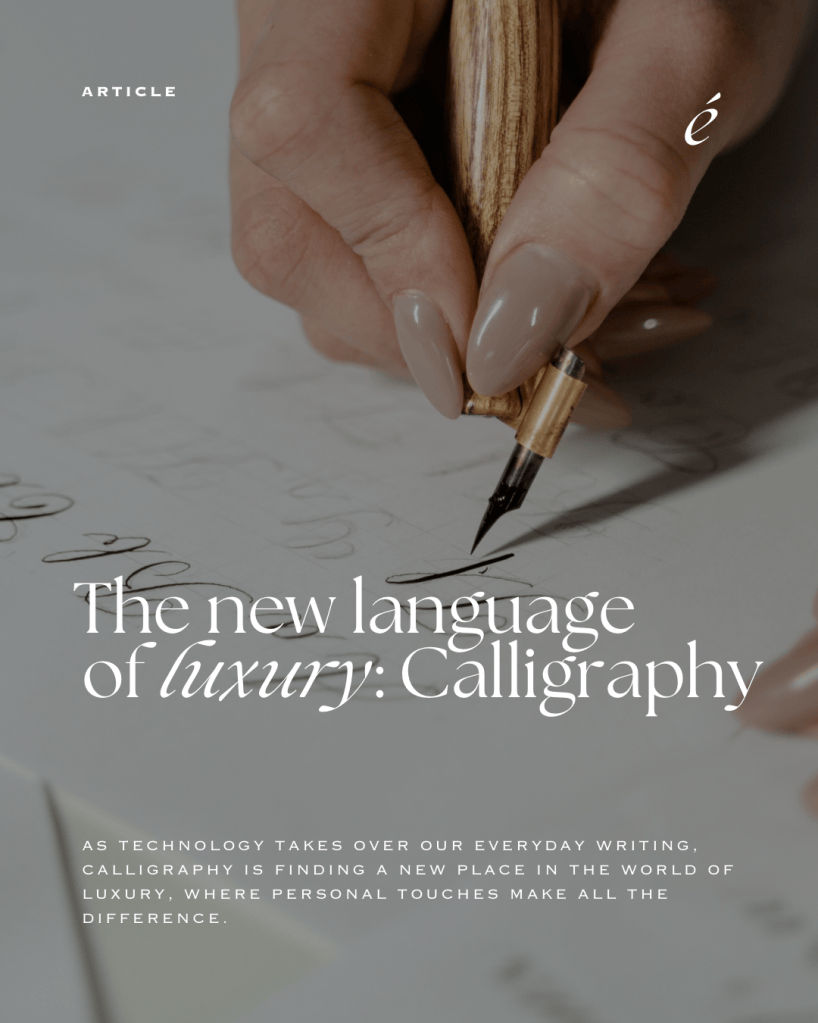
  • The New Language of Luxury: Calligraphy, Craftsmanship and Personalisation


    BY GIULIA LIU

    In 2020, Rosario Coluccia, a scholar writing for the Accademia della Crusca, Italy’s leading institution for the study of the Italian language, shared growing concerns among teachers about students’ handwriting skills, even among high school and university students.

    These concerns have been around for years. But it’s not as though words have disappeared from our daily lives, because we constantly write messages, emails and comments. What’s changed is how we put those words together. Our fingers are still hard at work; they’ve simply switched jobs. Between keyboards, touchscreens and autocorrect, the pen is slowly becoming a vintage accessory, pushed aside in favour of more convenient technology.

    Cursive writing, in particular, has become a topic of debate. There was a time when knowing how to write in cursive was as essential as knowing how to tie your shoelaces.

    Still, there’s an important distinction between not knowing how to write in cursive and simply choosing not to. For many students, cursive is no longer their first choice. A 2026 Italian study examining handwriting with a sensor-equipped pen found that 73.81% of the eighth-grade students involved preferred writing in print.

    Of course, choosing print doesn’t mean you’ve forgotten how to write in cursive. But the finding does tell us something interesting: a writing style that once ruled school notebooks no longer seems to be the natural choice for many young people.

    What’s interesting is that while schools are debating the younger generation’s handwriting skills, elsewhere people are actually getting paid to write by hand. If schoolbook cursive is going through an identity crisis, artistic calligraphy has found new ways to make itself desirable.

    Today, professional calligraphy can be a valuable skill to add to your creative toolkit. Calligraphers can work across craftsmanship, design and commercial communication, often collaborating with creative agencies, designers and brands.

    The luxury industry, in particular, has a soft spot for handwriting. In a world where almost anything can be reproduced endlessly, there’s something charming about someone taking the time to write something just for you.

    Imagine walking into a boutique and receiving a gift with a handwritten message created right in front of you. The product itself hasn’t changed, but the experience certainly has. That small, handcrafted detail turns an otherwise identical object into something that feels personal.

    It’s one of the little paradoxes of modern consumer culture: after perfecting the art of mass production, we’re now finding increasingly sophisticated ways to make everything feel one of a kind.

    One Italian example is Komoko Studio, founded by graphic designer and calligrapher Giulia Filippini. The studio specializes in live calligraphy, engraving and bespoke personalisation for events, with a portfolio featuring collaborations with brands such as Tiffany & Co. and Max Mara.

    Then there’s Versace, which, at a recent private event in its Milan boutique, invited professional calligraphers to personalise small leather accessories and keyrings on the spot. Guests’ initials were hand-painted with brushes, bringing together the art of calligraphy and traditional leather craftsmanship.

    Perhaps that’s what luxury is becoming: not about being perfect, but about being personal.

    Il Nuovo Linguaggio del Lusso: Calligrafia, Artigianato e Personalizzazione

    Nel 2020, l’accademico Rosario Coluccia, in un intervento pubblicato dall’Accademia della Crusca, riportava le preoccupazioni di diversi insegnanti riguardo alle crescenti difficoltà degli studenti nella scrittura manuale: lettere poco leggibili, collegamenti incerti e un curioso miscuglio di corsivo e stampatello. Questo sentimento di preoccupazione si respira già da molti anni e riprende una sorta di crisi d’identità alfabetica che, secondo le testimonianze raccolte, non risparmierebbe nemmeno gli studenti più grandi, quelli della scuola secondaria superiore e gli universitari.

    Non sono le parole a essere scomparse dalle nostre giornate. Del resto, scriviamo continuamente messaggi, email e commenti, ma a essere cambiato è il modo in cui produciamo tali parole. Le dita continuano a lavorare, semplicemente hanno cambiato mansione. Oggi, tra tastiere, touchscreen e correttori automatici, la penna rischia di diventare un accessorio vintage messo da parte in favore di strumenti tecnologici.

    Il corsivo, in particolare, è oggetto di numerosi dibattiti. C’è stato un tempo in cui saper scrivere in corsivo era una competenza indispensabile, al pari di allacciarsi le scarpe.

    Bisogna, tuttavia, ben differenziare l’incapacità di scrivere in corsivo dalla semplice scelta di non farlo. Spesso, infatti, semplicemente il corsivo non è più la prima scelta di molti studenti. Una ricerca italiana che ha analizzato la scrittura degli studenti attraverso una penna dotata di sensori ha rilevato che, tra i ragazzi di terza media coinvolti nello studio, il 73,81% preferiva utilizzare lo stampatello.

    Preferire lo stampatello non equivale a dimenticare come si scrive in corsivo, ma il dato racconta qualcosa di interessante: una forma di scrittura un tempo protagonista dei quaderni scolastici sembra non essere più la scelta spontanea di molti ragazzi.

    Eppure, mentre nelle scuole si discute delle difficoltà dei più giovani con la scrittura manuale, altrove qualcuno viene pagato proprio per scrivere a mano. Se il corsivo scolastico sembra attraversare una crisi d’identità, la calligrafia artistica ha trovato nuovi modi per rendersi desiderabile.

    Oggi, saper scrivere bene rappresenta un vero e proprio asso nella manica da aggiungere al proprio repertorio. Una bella calligrafia è utile alla realizzazione di partecipazioni di matrimonio, segnaposto, packaging, insegne, progetti editoriali, eventi privati e personalizzazioni dal vivo. Le opportunità spaziano dall’artigianato alla comunicazione commerciale, spesso attraverso collaborazioni con designer, agenzie creative e brand.

    Il lusso, in particolare, ha un debole per la scrittura a mano. In un mondo capace di riprodurre qualsiasi cosa all’infinito, l’idea che qualcuno dedichi del tempo a scrivere proprio il nostro nome ci affascina. Immaginate di entrare in una boutique e ricevere un regalo con una dedica realizzata a mano, davanti ai vostri occhi. Il prodotto resta lo stesso, ma l’esperienza cambia. Il gesto artigianale aggiunge una dimensione personale a un oggetto che, fino a pochi istanti prima, era identico a tutti gli altri. È un piccolo paradosso del consumo contemporaneo: dopo aver perfezionato i sistemi per produrre tutto in serie, cerchiamo modi sempre più sofisticati per far sembrare ogni cosa unica.

    Un esempio italiano è Komoko Studio, fondato dalla graphic designer e calligrafa Giulia Filippini, che propone servizi di calligrafia dal vivo, incisione e personalizzazione per eventi. Nel suo portfolio figurano collaborazioni dichiarate con marchi come Tiffany & Co. e Max Mara. Oppure, Versace che, in un recente evento privato nello store di Milano, ha invitato calligrafi professionisti per personalizzare sul momento piccoli accessori e portachiavi in pelle. In tale occasione, le iniziali dei clienti sono state dipinte a mano e a pennello per fondere la calligrafia all’artigianato della pelletteria.

    Il nuovo concetto di lusso forse è proprio questo: non essere perfetto, ma essere personale.

  • Elizabeth McIlwee, Founder of MRBL, on When Design Is Duplicated: What Makes the Original Worth More?


    INTERVIEW with ELIZABETH MCILWEE

    In a world increasingly driven by fast consumption and affordable alternatives, creating something original comes with an unavoidable risk: someone else can copy it and sell it for less. For independent designers and emerging brands, the challenge is not simply protecting an idea, but communicating the value behind it when cheaper imitations begin to compete with the original.

    For Elizabeth McIlwee, founder of MRBL, this reality is part of building a brand rooted in thoughtful design and quality materials. Inspired by her own bathroom renovation and her longstanding fascination with marble, McIlwee created the Marble Hairbrush to bring a traditionally luxurious material into everyday life. Her vision was simple: transform an ordinary object into something meaningful, encouraging people to slow down and appreciate the rituals that shape their days.

    But when a product is defined by its appearance, what happens when that appearance is copied using less expensive materials?

    When Appearance Becomes a Commodity

    In today’s marketplace, a product’s visual identity can quickly become its most vulnerable feature. A distinctive shape, a recognisable silhouette, or a carefully considered design can be reproduced, allowing imitations to reach consumers at a fraction of the original price. Yet what looks similar on the surface may be fundamentally different in its construction, material, and intention.

    For MRBL, marble is central to that distinction. McIlwee chose Calacatta Viola for its dramatic veining and natural variation, ensuring that every Marble Hairbrush is unique. Unlike mass-produced materials designed for uniformity, natural marble carries its own character, shaped by geological processes over immense periods of time.

    This individuality challenges the idea that a product can be fully replicated simply by copying its form. Even when another brand recreates the silhouette, it cannot reproduce the exact stone, its natural markings, or the particular qualities that make each original piece distinct.

    As McIlwee explains, “That’s the reality of creating something new: it can be copied, but it can never truly be replicated.”

    Her perspective highlights an important distinction between imitation and originality. While the outward appearance of a product may be reproduced, the material choices, development process, and creative decisions behind it are far more difficult to duplicate.

    The Hidden Cost of a Cheaper Alternative

    When consumers compare an original product with a less expensive alternative, price is often the most immediate difference they notice. But price alone does not tell the full story.

    Developing an original object requires more than arriving at an appealing design. It involves time, experimentation, material selection, and the ability to turn an idea into a finished product. When an imitation uses cheaper materials to achieve a similar appearance, much of that creative and developmental work may be invisible to the consumer.

    For independent founders, this creates a particular challenge. They must compete not only with other original products but also with copies that borrow the visual language of their designs without necessarily reflecting the same investment in materials or craftsmanship.

    McIlwee believes that purchasing an original means investing in the process behind the object, not just the object itself.

    “When you buy a Marble Hairbrush from MRBL, you’re not only buying the hours that went into carving it. You’re investing in the years it took me to develop my eye for design, to find the idea, and to see it all the way through to execution,” she says.

    Her words point to a part of design that is easily overlooked: the value of the experience and judgment required to create something in the first place. An imitation may resemble the finished product, but it does not represent the same creative journey.

    This does not mean that every affordable alternative is necessarily inferior. Rather, it raises a more important question for consumers: Are we paying only for the way something looks, or for the materials, thought, and craftsmanship that make it what it is?

    Beyond the Copy: The Value of Original Design

    For McIlwee, the issue extends beyond competition. It reflects a broader culture of consumption in which objects are frequently purchased for their immediate appeal and replaced as soon as something cheaper or newer becomes available.

    Her alternative is to encourage a more considered relationship with the things we own. Instead of accumulating several inexpensive objects, she advocates investing in fewer pieces that are meaningful enough to keep for years.

    “We’ve gotten used to buying things that are meant to be replaced. I would rather someone own one beautiful thing they keep for years than five things they throw away,” she says.

    This philosophy is particularly relevant to products that occupy a place in our everyday routines. A hairbrush may be an ordinary necessity, but MRBL approaches it as an object worthy of attention, both for its material qualities and for the experience of using it.

    The brand’s ambition is to make everyday rituals feel more intentional, reminding consumers that design does not have to be reserved for furniture, architecture, or objects displayed behind glass. It can also exist in the small things we reach for every morning.

    In this context, the value of an original product is not determined solely by its exclusivity or price. It also lies in the relationship between its design, its material, and the person who chooses to live with it.

    Protecting the Idea Behind the Object

    For emerging brands, the possibility of imitation is difficult to avoid entirely. A successful design can attract attention, but that visibility can also make it more susceptible to being copied. Competing with cheaper alternatives therefore requires more than emphasising what makes an original product different; it requires building a brand whose identity extends beyond a single object.

    McIlwee remains confident that MRBL’s future is not limited to the Marble Hairbrush. She sees it as the first expression of a larger vision, with more objects to come.

    That distinction matters. When a brand is built around a clear philosophy, its value is not confined to a recognisable shape that another manufacturer can reproduce. It grows from a consistent approach to materials, craftsmanship, and the role objects play in everyday life.

    Ultimately, the challenge of imitation forces both brands and consumers to reconsider what makes a product valuable. If design is reduced to appearance alone, the cheapest copy may seem like the obvious choice. But when material, intention, and the creative work behind an object are taken into account, the comparison becomes more complex.

    A copy can reproduce a look. It can compete on price. But originality encompasses more than what the eye can see.

    For McIlwee, that is the distinction worth preserving: “A dupe copies how something looks. It can’t copy why it exists.”

  • THE SACRED ART OF MOROCCAN HENNA


    Henna, sometimes called hanna, is more than a short-term decoration on the body or a beauty mark in Morocco; it is a link that is part of Morocco’s history, spirit, and daily life.

    BY LUIGINA D’INTRONO

    Henna comes from the dried, crushed leaves of a plant called Lawsonia inermis. This plant has been grown in North Africa and the Middle East for a long time. In culture, this simple
    green powder becomes a strong sign of baraka, which means holy grace or a blessing, protection and strength for women. To learn about the use of henna in Morocco is to enter a
    tradition of health, beauty and happy times with others.

    The Science and Art of the Natural Color
    The special power of henna comes from a chemical called lawsone, which is a red-orange color found in the leaves of the plant. When the leaves are made into a powder and mixed
    with a bit of acid like lemon juice, orange blossom water or tea, the lawsone comes out. When this mixture is put on the skin, it connects with the keratin in the layers of the skin, leaving a
    warm orange-brown color that gets darker over 24 to 48 hours and can stay for up to three weeks.

    In Moroccan beauty traditions, henna is loved for both the way it looks and the way it feels. It is used not for decoration on the skin but also as a deep conditioning treatment for hair and as a natural way to cool down feet and hands during hot summer days. Its natural ability to fight germs made it a helpful way to treat skin problems and keep away infections in the past.

    The Night of Henna: a special event Henna can be used for decoration, but its most important use is during big life events, especially Moroccan weddings. The wedding celebration often lasts for days and includes a
    special evening called Laylat al-Henna.

    This event happens the night before the wedding. Is a private gathering for women only. The bride wearing a green dress sits in the middle of the group surrounded by women in the family, friends and older people. The place is full of music beating drums and the smell of burning incense and rosewater.

    A skilled artist, called the neggafa or hannaya carefully puts designs on the bride’s hands and feet. This process has a meaning:

    Protection from bad things: Some shapes, like triangles, diamonds and special eyes are drawn to stop bad energy from coming.

    Bringing luck: Small flowers and palm shapes are added to bring good things like having a baby being rich and being happy in the new marriage.

    Connecting and sharing: While the bride sits still and the henna dries older women tell stories laugh and give advice about marriage making the time spent together a way to pass down knowledge from one generation to the next.

    When the bride’s henna is finished any leftover paste is given to women there giving them the same blessing so they too can find happiness in marriage.

    Styles: bold lines vs. beautiful flowers
    Moroccan henna looks different from the thick detailed designs of Indian mehndi or the delicate lace-like styles of the Arabian Peninsula. Within Morocco, some styles show the countrys many regions and cultures:

    Berber (Amazigh) Designs: These come from the mountain areas and rural parts of Morocco. Amazigh henna has clear shapes like lines, diamonds, triangles and symbols that show fertility, nature and the tribe.

    Fassi Style: This style comes from Fez, the center. Fassi designs are very detailed. They use lots of lines and patterns that need a lot of skill to make.

    Sahrawi Styles: In Morocco and the Sahara Desert, the designs often have big bold flowers and flowing lines that look different against the skin.

    A tradition that lives on today
    In Morocco henna keeps changing but still keeps its main identity. Today Moroccan women often mix Amazigh patterns with new flower designs for special events like Eid, baby naming
    (Aqiqa) or casual get-togethers.

    Even though expensive spas and modern shops in cities like Marrakech, Casablanca and Tangier now offer henna treatments with beauty services, the real meaning of the tradition is still in the home. It is a caring act that shows joy, friendship and a connection to the past, shown clearly on the skin.

  • TRADITIONAL MEDICINE: BRAZIL


    BY ANGELICA KLYCE

    In Salvador, Brazil, the walls of Sala dos Milagres tell the stories of generations of bodies that have suffered and been healed. Photographs and handwritten notes are archived here, but most special of all small representations of arms, legs, hearts and other parts of the body that have been left behind as ex-votos offerings, in thanks for prayers that have been answered.

    Each object represents an experience of illness, hope, fear, and recovery. A question that has followed the healing practices far beyond the walls of the room: what counts as medicine? Is healing only something that happens in hospitals or laboratories, or can it also live in a plant grown in a grandmother’s garden, a prayer whispered by a benzedeira or a ritual passed from one generation to another?

    Across Brazil, medicinal traditions of healing have developed through Indigenous knowledge, African diasporic practices, European fold customs, faith, and the county’s extraordinary natural environment. All contributing to reveal that medicine can be more than the treatment of the body, but also a way of remembering who we are and how to care for one another.

    There is No Single Brazilian Traditional Medicine

    The assumption that Brazilian traditional medicine is one unified practice would miss what makes it so different to the rest of the world. Brazil’s healing traditions developed across an enormous country inhabited by diverse populations of people, environments, religion, and history.

    Long before Portuguese colonization, Indigenous peoples had already developed sophisticated knowledge of the plants and ecosystems around them. A recent review of research on Jê Indigenous peoples alone identified 609 plant species managed for food and medicinal purposes. Through Colonization new andoften violent additions were made to this history. Portuguese settlers brought European remedies, catholicism, and folk practices, while enslaved Africans carried knowledge of healing, spirituality, and plants across the Atlantic. Over generations, practices were preserved, adapted, exchanged and sometimes blended. Brazil inherited something closer to a mosaic when it came to their understanding of what it means to heal, put together by the diverse communities inhabiting its lands.

    Traditional Healing in Brazil

    The knowledge contained in these plants is dependent on the people who use them. One of the most recognizable figures in Brazil is the benzedeira (benzedor for men), traditionally a woman who performs benzeção (blessings) that combine spoken prayers, gestures, and sometimes medicinal plants. The knowledge is often passed down orally within families. A recent study in Minas Gerais found that patients did not see visiting a benzedeira and a doctor as contradictory; for some Brazilians, both forms exist alongside one another.

    There are more tangible remedies. Garrafadas are bottled preparations typically made by combining medical plants, roots, or bark, often in an alcoholic liquid. They are used for a wide range of purposes in Brazilian folk medicine. Plants sometimes take meanings beyond their chemical properties. In Afro-Brazilian religions such as Candomblé and Umbanda, leaves may be used in teas, herbal baths, ritual washing, and cleansings with smoke. Another tradition continues is parteiras tradicionais or traditionalmidwives. To this day they assist with births in rural, riverine, forest, Indigenous, and quilombola communities in the north and northeast parts of Brazil.

    Traditional plant medicine has even entered modern Brazilian public Healthcare. The O Sistema Único de Saúde (SUS) maintains policies for medicinal plants and phytotherapy, and twelve herbal medicines are currently included in Brazil’s national essential medicines system. These include Brazilian medicinal plants such as guaco, espinheira santa, and aroeira.

    Brazilian traditional medicine is not any single remedy, but the act of passing down knowledge. A prayer remembered, a plant recognized, a technique taught from one pair of hands to another. Each piece of knowledge becomes a small inheritance. These traditions are traces of people who were sick, cared for, and carried that memory for generations to come.

  • COPY-PASTE COUTURE: WHY EVERY FASHION BRAND SUDDENLY LOOKS THE SAME


    If your feed, the boutique windows on your street, and every glossy magazine cover have started blurring into one long déjà vu, you’re not losing it.

    BY DAYANA KAZANGAPOVA

    Fashion and branding are in the middle of a real identity crisis. Experimentation, archival depth, and aesthetic personality have been flattened into a single house style.

    A century-old couture maison’s logo now looks like a tech startup’s wordmark. A Paris runway look is hard to tell apart from this season’s fast-fashion lookbook. Here’s how that happened, and why chasing a younger audience backfired so badly.

    The De-Branding Era: Luxury’s One-Font Policy

    The clearest symptom is in the logos themselves. Over the past few years, brand after brand: Balenciaga, Burberry, Saint Laurent, Balmain, Celine, Boss, Berluti, stripped out their signature typography: hand-drawn scripts, ornate serifs, monograms, crests, all the visual DNA built up over decades.

    What replaced it was nearly identical everywhere: a heavy, no-frills sans-serif. Insiders started calling it “the Great Sans-Serif Epidemic”. The official justification was practical: it reads well on any screen; a bold sans-serif holds up on a five-inch phone just as well as a flagship model. It scales cleanly; a simple mark doesn’t degrade whether it’s on a billboard or an app icon. But underneath the technical reasoning was a much bigger bet: that this was how you talk to Gen Z, the generation that now drives the market.

    The “Gen Z Wants It Simple” Myth

    Brands assumed young people, raised on phones, couldn’t handle visual complexity and wanted everything dumbed down. That assumption was wrong. Gen Z is arguably the most visually fluent generation ever: fluent in Y2K aesthetics, early-2000s web clutter, 3D graphics, maximalist type. Complexity was never the problem. The real pressures pushing brands toward simplicity were different: the half-second attention war is in a TikTok or Instagram scroll; a logo has about a second to register. A fine serif reads as noise at that speed; a bold sans-serif doesn’t. Shedding the snob image, ornate branding reads as old, exclusive, unapproachable. A stripped-down wordmark felt closer to streetwear, more democratic, less stuffy. The blank-canvas logic is a simple logo that prints cleanly on a hoodie, drops into a meme, or sits over a video without fighting the content around it.

    Why did it backfire?

    Brands overcorrected, and in the process, gave up the thing that actually made them worth caring about: character. Gen Z, who prizes authenticity above almost everything, got bored fast with sterile, interchangeable “quiet luxury”. The response was a swing toward vintage shopping, archive-diving, and a general revolt against beige-on-beige sameness.

    Musical Chairs: The Designer Merry-Go-Round

    While marketing teams were busy homogenizing logos, the runways had their own version of the same problem: the same handful of star designers keep rotating through different houses, and they bring their signature with them wherever they land.

     Demna carried the oversized, deconstructed, internet-native aesthetic he built at Vetements straight into Balenciaga, and it became the house’s new baseline.

     Daniel Lee took the chunky woven leather and the acid-green palette that defined his Bottega Veneta into his next job at Burberry.

     Hedi Slimane has run the same playbook: skinny silhouettes, rock-and-roll, indie-sleaze, at Dior Homme, Saint Laurent, and Celine alike, regardless of each house’s own history.

    A designer switching houses doesn’t just bring an idea, they bring the whole apparatus: the tailor, the pattern-cutters, the stylists, the mood boards, even the fabric suppliers. The house itself stops being the story; it just becomes the venue for whoever’s currently in the job.

    Algorithms, Microtrends, and the Collapse Into Mass Market

    The third force is data. Luxury conglomerates now lean on sales dashboards and virality metrics more than on creative instinct.

    Microtrends on a conveyor belt

    TikTok turned trend cycles into a production line. “Quiet luxury,” “mob wife,” “office siren,” “coquette”, each one peaks and dies within months. Because every brand’s analytics team is watching the same signals, design teams across competing houses end up chasing the same brief at the same time. That’s why Milan, Paris, and New York keep showing near-identical ideas within days of each other during fashion month.

    Luxury and fast fashion, merging in real time

    The old model was simple: luxury sets the trend, fast fashion copies it a few weeks later. That’s gone now. Fast-fashion players don’t just copy anymore: they hire the couture names directly, putting designers known for elaborate, theatrical tailoring onto mass-market racks. Meanwhile, luxury houses are simplifying their own output to perform better on social algorithms. The two ends of the market are meeting in the middle.

    The Breaking Point: Robots on the Catwalk

    This whole trajectory hit a strange climax at Vogue World 2026 in Milan. Inside the Galleria Vittorio Emanuele II, a segment called “The Age of Intelligence” put humanoid robots on the runway alongside human models, walking in time to the music, waving at the crowd.

    What actually made headlines wasn’t the robots. It was the front row. Footage of veteran designers watching the robots with open skepticism went around the industry press almost immediately.

    That reaction captured the real problem: no algorithm or robot can generate meaning on its own. Code can optimise a supply chain or forecast a color palette, but it can’t replicate human emotion, a hand-draped garment, or a genuine point of view.

    What Comes Next?

    Fashion has always moved like a pendulum. A stretch of extreme minimalism and mobile-optimised branding tends to trigger its own backlash. People are tired of sameness, and the appetite for something with actual character is already building…

  • VENICE FILM FESTIVAL AND THE RE-WEARING CULT


    Sustainable fashion, reconsidered: what the Venice Film Festival’s red carpet reveals about re-wearing.

    BY CHIARA DI LEO

    In recent days, Venice hosted one of the world’s most important festivals: the Venice Film Festival: the Venice Film Festival. During this special event, many films are presented, and directors are rewarded, but that’s not the only thing that matters…Fashion and trends are under public scrutiny, and this event and its red carpet become the centre of attention for both the beauty-related world and the film industry.

    This year, the art of “re-wearing” made headlines and on Instagram profiles; celebrities are wearing archive pieces or re-wearing other outfits from their collections.

    The undeniable queen of this art is surely Cate Blanchett. Continuing her personal mission against disposable red-carpet couture, Blanchett once again this year prioritised longevity over novelty, wearing pieces from previous seasons and pairing them with repurposed, deadstock fine jewellery rather than newly minted pieces.

    Generally, rather than debuting custom gowns straight out of new collections, several celebrities turned to fashion history, pulling archival silhouettes, notably 1990s and early-2000s couture from houses like Giorgio Armani Privé and Jean Paul Gaultier, proving that old gowns and craftsmanship can easily outshine rapid-cycle trends. This trend doesn’t only affect red-carpet looks, but also the Lido guests actively re-wore daytime essentials across multiple photocalls: tailored vintage blazers, classic leather footwear, and heritage accessories.

    From these examples, we can fully understand the weight and importance of this relatively new trend.

    The biggest outcome of this new tendency is surely its impact on overconsumption and the change in fashion choices in our daily life. This isn’t only a red-carpet phenomenon, it mirrors a much larger shift already underway among younger consumers; new generations are looking for vintage shops and for inspiration online on how to style one or multiple pieces in their wardrobe.

    Gen Z doesn’t buy vintage clothes only because of its positive impact on the environment, but mainly because it loves wearing vintage clothing. Young adults and teens make this choice because an old garment can make you stand out and differentiate you from others, but also matching different pieces makes you unique and builds your confidence and self-identity.

    Behind the rediscovery of garments from past times, there is the need to tell who you are, to differentiate yourself, and to build a personal identity through unique choices and objects. 

    Confirming this change in why young consumers buy vintage is a study published both on the “SDA Bocconi Insight” website and in the Journal of Consumer Behaviour by the researcher Generoso Branca. This theory was based on an analytical analysis:

    Surveying over 390 young Italians aged 18 to 25, the authors reveal that individual desires and emotional satisfaction, specifically fashion involvement and the search for uniqueness, are the real drivers behind vintage purchases, outweighing green or ideological concerns. The increase in prices when shopping for clothes also pressured teens and adults to look for different ways to obtain good quality pieces.

    Gen Z outnumbers other generations in buying vintage clothes, preferring searching and picking pieces in a vintage market rather than online. Choosing and re-wearing become an art and a fashion statement.

    At the end, some numbers to understand the scale of this phenomenon: the global secondhand fashion market reached $197 billion in 2023 and is projected to grow to $350 billion by 2028. Gen Z and millennial shoppers are the demographic most driving that growth, with much of their secondhand buying happening online

    Ultimately, the Venice red carpet and the choices of Gen Z converge on the same truth: the art of re-wearing has evolved from an environmental duty into the ultimate form of self-expression. By rejecting the culture of disposable couture, celebrities and young consumers are both proving that garments gain value through history. In an era saturated with fast trends and fast fashion, re-wearing an outfit is no longer an act of repetition or a shame as it was in the early 2000s; it is a fashion statement one can make.

  • “SOUTH SUDAN’S ANGELS: THE COST BEHIND THE LOOK”


    “Ebony skin, long limbs, angelic face: these are the dehumanised models.”

    BY CHRISTINE AMEFIAM

    South Sudanese people are the most sought-after models at the moment; what makes them stand out is their dark skin, features and long limbs. Some of the most famous models include Nyakim Gatwech, Anok Yai, and Adut Akech.

    Let’s hear about the history of their country. South Sudan is an East African country hosting more than 64 distinct ethnicities. They are among the world’s tallest populations, reaching an average of 6 feet; they are known to have one of the darkest complexions in the world. The most common ethnicities are the Dinka, Nuer, Shilluk and Azande; these are the features we are most familiar with.

    As published last year by the BBC: The African country producing fashion’s favourite models explains the choice made by the designers and modelling industry: “cheekbones, strong bone structures, long limbs, and elegant proportions“

    As (adorebior) Bior, a South Sudanese model and youtuber have stated, the term elegant proportions comes from the early 20th-century colonial administration and travel literature book written by Captain R. C. R. Owen’s 1908 observations on the Bari people; they were considered “well-built, well-proportioned, or fine-raced.

    Not all that glisters is gold. Some models had to flee from forced marriages, wars, and refugee camps in search of a better future.

    As much as they are praised for their almond eyes, long, slim necks, upright foreheads, pronounced chins, and balanced profiles, making them pleasant to look at, some models felt dehumanised by the industry. As stated by Misslado, photographers want ebony skin only paired with bright colours; little of their features are shown, and the only main theme is their skin complexion. “I feel ugly in some of the makeup they put on my face, but they end up telling me that I look good”, says the model Misslado. Everything is overplayed because the face isn’t important; the skin is.

    Grace Jones spent a career building that severe, androgynous, otherworldly image; it was hers, deliberate, a statement she made about herself. Now the industry has lifted that same look wholesale and is stamping it onto every dark-skinned model who walks through the door, regardless of who she actually is. It stops being Jones’ art and becomes a costume the industry hands out.

    Having such a “fallen angel” look is one of the most complex realities you have to live with.

    Some models such as Alek Wek and Anok Yai have shared their struggles of either being bullied for their complexions or being called ugly by one person and immediately gorgeous by another. This is a great paradox they still have to face on a daily basis.

    Still not being accepted as one of the beauty standards is immensely unbearable.

    These models had to go through so much to reach where they are, and on top of that, they end up being dehumanised.

    The question is: why are they focusing only now on South Sudanese models? Is it because it’s a trend? The answer is yes. This isn’t just a feeling; the numbers back it up. As of March 2026, nine of the fifty models on Models.com’s influential Top 50 ranking were of South Sudanese origin, roughly 18% of the list, out of a country of about 12.2 million people in a world of more than eight billion. Vogue’s 2025 “faces to watch” feature included four South Sudanese models out of eleven picks. Doris Sukeji, who runs a modelling agency in Juba, has been blunt about the mechanics: “Mostly it’s the skin colour. That is how most of the South Sudanese get signed. They are looking for very dark models.” Fashion outlets covering the boom have themselves raised the possibility of “oversaturation”.

    But the pipeline feeding that runway success has a harder edge. Reporting from 2023 found European modelling agencies actively scouting South Sudanese teenagers who had fled the country, flying them to Europe for castings. Those who don’t get signed are sent home without follow-up, sometimes carrying debt from the trip itself. That’s not a system built around individual discovery; it’s a supply chain built around a look, with real financial and personal risk carried by the people being scouted.

    Trends move on. When the industry’s attention shifts to whatever look comes next, what happens to the models who were only ever wanted for one thing? Skin colour is not a trend. A human is not a canvas to play with.

  • ACCESS DENIED IF NOT ELEGANT ENOUGH


    JEUDI éCHOS x UMA SOCIETY

    The way we dress, for some races, can be just as important as what we are saying.

    For many people, a simple white T-shirt, a pair of jeans and sneakers can be enough to grant them access to almost any space they want to enter. For others, even when dressed as elegantly as possible, suspicion can still arise. We are not all perceived equally.

    This is what makes the conversation around Black style so interesting to me.

    I often hear people argue that the “old money” aesthetic does not belong to Black identity. But why? Was it truly never part of our culture, or was it simply never represented often enough to become associated with it?

    Black luxury has always existed. We have seen glimpses of it in television, film and popular culture: Black characters, families and communities portrayed through wealth, sophistication and refinement. Yet when conversations about luxury or the “old money” aesthetic arise, these representations are often forgotten.

    Perhaps it is because people are not accustomed to seeing Black people through that lens. Or perhaps, for some, sophistication is still difficult to reconcile with their idea of Blackness.

    When we think of an old-money or minimalist aesthetic, we tend to associate it with refinement, elegance, discretion and sophistication. Yet Black people are often excluded from that image.

    Ask someone to describe “Black style”, and you may hear the same familiar stereotypes: baggy clothing, hip-hop-inspired looks, an edgy aesthetic, large hoop earrings and extremely long animal-print nails. When speaking about Africans, the conversation can become equally reductive, often limited to inexpensive or stereotypical interpretations of traditional Kente clothing.

    But why is the conversation so rarely extended to the Black man or woman in a perfectly tailored suit, a minimalist dress, polished shoes, subtle jewellery or a timeless, understated wardrobe?

    Why can’t Blackness be associated with sophistication too?

    And perhaps more importantly, who gets to decide what sophistication looks like?

    Does an aesthetic somehow become more legitimate when it is worn, endorsed or popularised by someone outside of the Black community? When a major fashion house takes inspiration from the style of a Black person, that aesthetic can suddenly be reframed as luxurious, refined or desirable. Yet when that same sophistication comes directly from a Black man or woman, why can it sometimes be harder for people to recognise it?

    Papa Wemba, one of the great promoters of la SAPE (Société des ambianceurs et des personnes élégantes), famously said, “White people created clothes and Black people created style.”

    And perhaps that is the point.

    Black style has never been one thing. It has always contained creativity, elegance, experimentation, extravagance and restraint. The fact that one particular version has become more visible than another does not make it more authentic.

    A lack of visibility does not mean a lack of existence.

    And elegance certainly does not belong to one aesthetic. Wearing monochromatic clothes does not automatically make someone sophisticated, just as wearing bright colours does not make someone less elegant. Style comes from knowing how to combine what you wear, how you carry it and, ultimately, how you feel in it.

    Elegance is not confined to one race, nationality, class or culture.

    So, to the Black person reading this: the next time you want to dress in a simple, formal and sophisticated way, remember that this, too, can be part of your lineage. You do not need permission to claim elegance. You do not need to fit the stereotype of what Black style is supposed to look like.

    Because ultimately, this conversation is not only about clothes. It is about access.

    It is about what happens when we enter spaces where we have historically been made to feel that we do not belong. It is about being seen, being taken seriously and feeling confident enough to occupy the room we have entered.

    And that is where UMA SOCIETY enters the conversation.

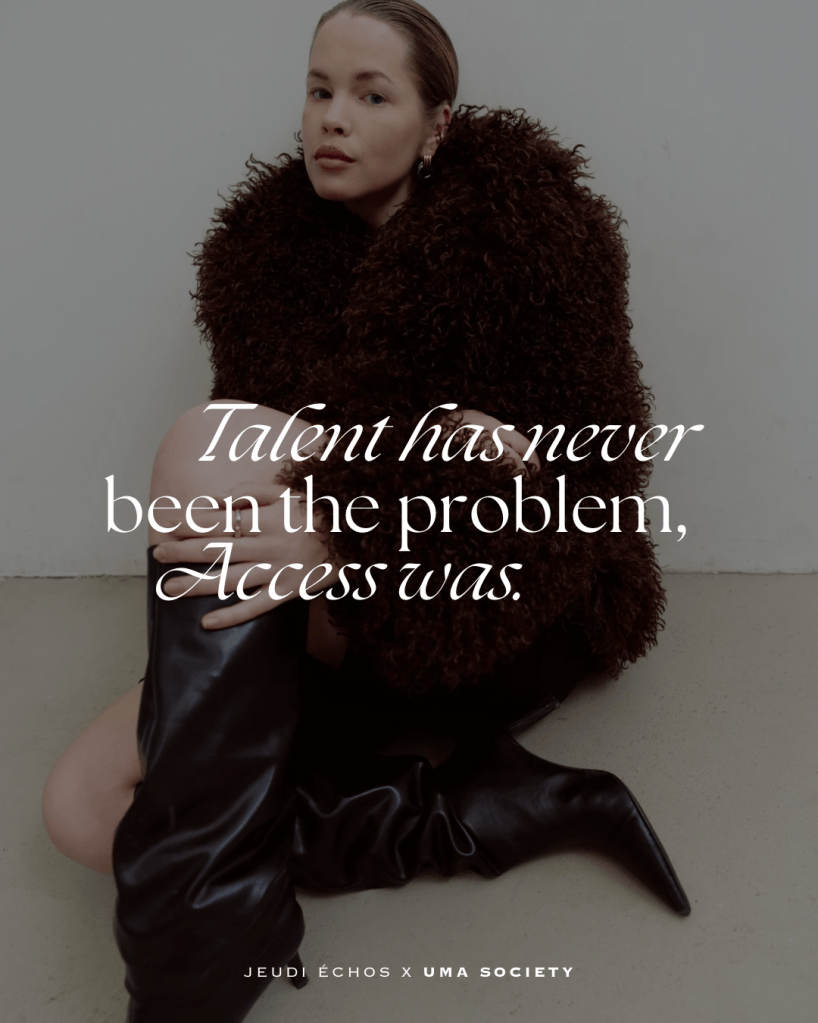
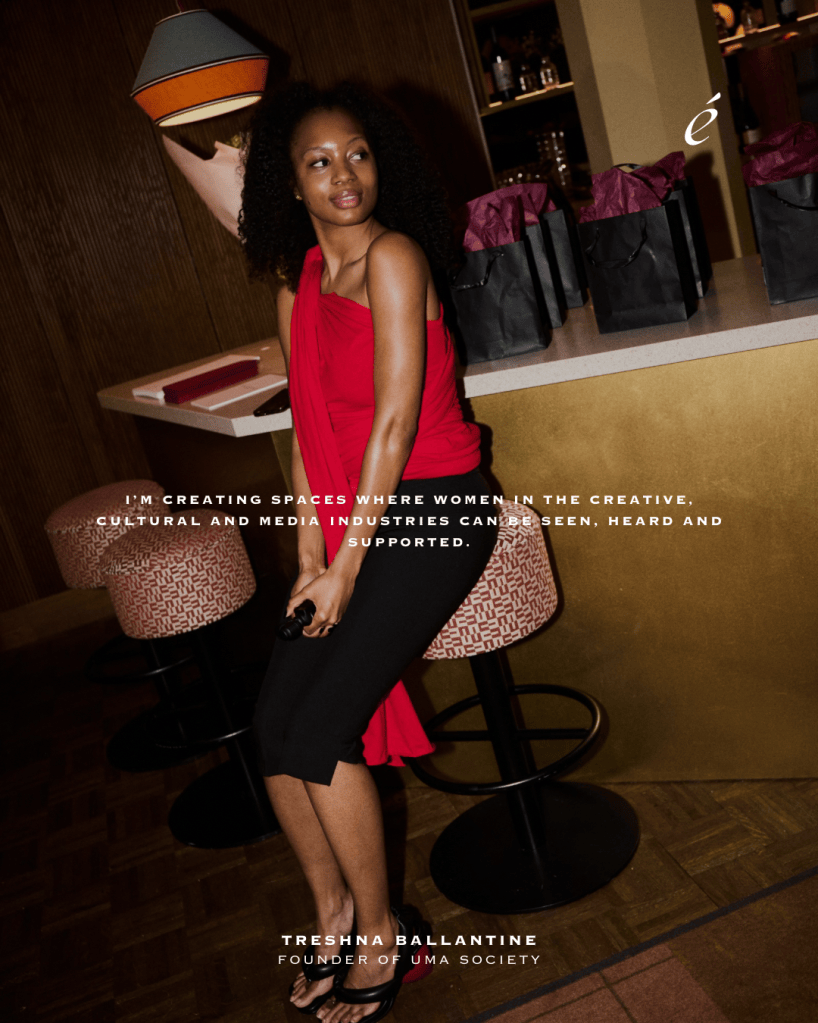
    Treshna Ballantine, the founder of UMA SOCIETY, describes the organisation as a platform and community for women in the creative, cultural and media industries. The idea began two years ago, born from a frustration that is familiar to many women: talent was never the problem. Access was.

    Sometimes what is missing is not ability, but opportunity. Being in the right room. Being seen by the right person. Having someone open a door that might otherwise remain closed.

    UMA SOCIETY was created to help change that.

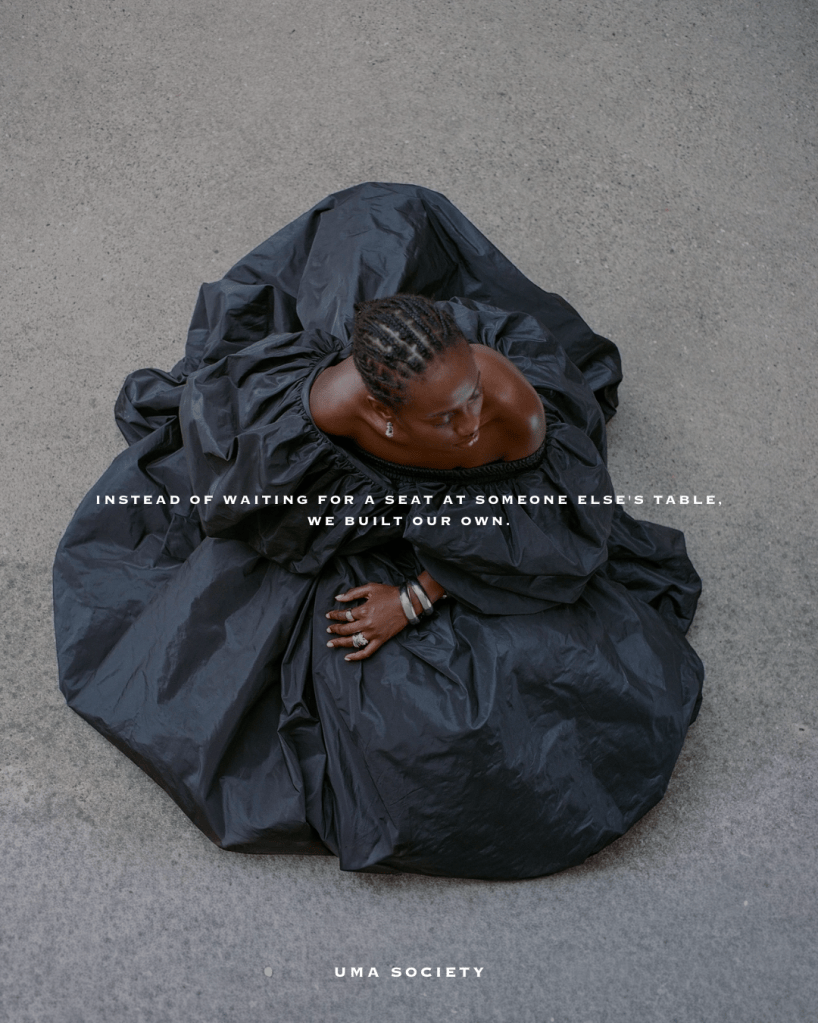
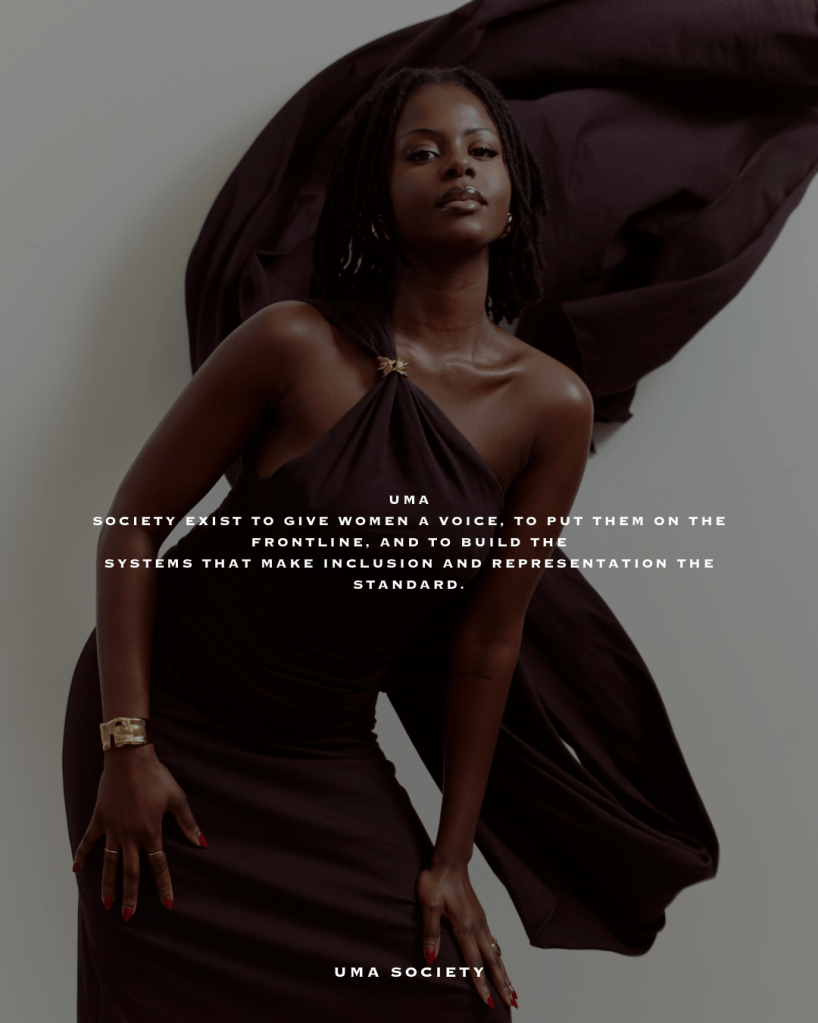
    Rather than waiting for someone else to create the opportunity, Treshna built the kind of space she herself had been looking for: one where women could be seen, heard and supported, and where inclusion and representation could become the standard rather than the exception.

    Through events and partnerships with people and brands that share those values, UMA SOCIETY creates spaces designed to help women grow in their careers and on their own terms.

    In many ways, this is the same conversation.

    Because how we dress is one part of how we choose to show up in a room. But confidence is not only about posture and poise. It is also about feeling comfortable enough in your own identity to take up space.

    As Treshna, the Founder of UMA SOCIETY, puts it:

    “Elegance is the way you move through the world, how you carry yourself, how you act, the grace you bring to everything you touch. To me, elegance is an energy. Something you hold, something you attract. It lives in how you treat people and in how people find themselves drawn to you because of it.”

    There is something powerful about entering a room knowing that you belong there.

    When you are dressed in a way that makes you feel confident, and you carry yourself with that same confidence, you are not asking for permission to be there. You are simply taking your place.

    So the next time you walk into a room, own your look, your elegance and, most importantly, your presence.

    Let yourself be seen at a greater distance than the stereotypes that have been placed upon you.

    Because a person is not valued by what she wears, but by who is wearing it.

  • EQUATOR ECHOES MAGAZINE


    INTERVIEW WITH ALESSIA D’INTRONO

    What inspired the creation of Equator Echoes Magazine?

    The art magazine Equator Echoes was born during my university studies and developed over five years of continuous independent research. Its creation was gradual: there wasn’t a single source of inspiration, but if I had to think of one particular event, I would mention a philosophy symposium I attended while studying visual arts. During the symposium, I discovered that the current world map we all know is the result of an ethnocentric vision of the globe, which still influences politics, economics, and cultures today. The way we see and relate to the world also starts here: with a map that distorts the size of certain continents and places the West at the centre of our gaze. This was the driving force behind what is now the magazine.

    This reflection also gave rise to a question that has become fundamental to me: who tells the story, and who has the power to define the world, and from what position do they do so? From there came the need to question who produces knowledge and representations, and from what position different contexts are narrated. This also applies to the way we approach publishing: we want to create a space for dialogue, research, and exchange.

    What does it mean to you to tell stories about Africa today?

    Africa is a vast continent. Talking about it always means leaving something out, but as the editor-in-chief of a magazine, I do not aspire to tell its story from a single point of view. One thing that has been fundamental to my journey is listening.

    The magazine already has its first writers, who are also artists or curators, from Africa and other continents. This is particularly meaningful to me because the goal is not to replace one centre with my own, given that I am Italian. It is about looking, listening, putting myself into perspective, and learning.

    Looking at African arts also means going beyond the stereotypical idea of African art as something connected solely to craftsmanship or tradition. It means recognising the plurality of practices, languages, and ways of creating art and culture that exist across the continent. One thing I have learned throughout this journey is that art and culture are deeply interconnected and complement one another.

    How do you choose the stories that deserve to be told?

    There are no stories that deserve to be told more than others. Curiosity is what drives the magazine. Sometimes it is precisely during an interview or a conversation with an artist that stories or aspects of their life and journey emerge that I was previously unaware of and that continue to surprise me. The choice therefore often comes from encounters and research rather than from a predetermined idea of what should be told.

    The choice we make concerns above all the way we write, avoiding celebratory or promotional texts and prioritising contributions, insights, and perspectives that can open up reflection and dialogue.

    Who has the right to define what an “African story” is?

    No one has that right. I believe that the attempt to construct “an African history,” “African art,” or “African authenticity” is what, more than anything, reduces Africa to a series of stereotypes. This attempt has been, and continues to be, predominantly Western.

    Categorisation and classification, through pseudoscientific disciplines that developed between the eighteenth and the mid-twentieth centuries, contributed to defining Africa to diminish it and fit it into constructs created by Europe for Europe. These disciplines served to ideologically reinforce colonialism and a sense of superiority that went unquestioned for a very long time and still persists today. Until our own time, “African history” did not even matter in the West. What was primarily sought was a “European history” within Africa, to justify precolonial and colonial atrocities.

    Now, however, it has acquired a certain appeal as an object of interest. Fashion and art, above all, are turning it into a trend. We can see this, for example, in recent biennials and art fairs. Undoubtedly, recognising the value of African and diasporic people is a necessary step, but that does not mean they need to be defined by us to have value.

    The magazine, too, was not created to give importance to anyone, but to discover and make known realities that already exist, that have already developed their own paths, and that are often bringing themselves into the spotlight.

    Do you think Africa is still too often represented through narratives constructed outside the continent?

    Absolutely. Advertising campaigns and media representations of humanitarian and health emergencies, for example, still too often portray the image of a continent in decline, lacking autonomy and stable economies. The recurring stereotype is that of an Africa portrayed as a collection of problems to which the West must rush to offer assistance. This narrative erases a fundamental part of history: many of the situations that still require intervention are also connected to the consequences of the colonial past and to the ongoing extraction and appropriation of resources that, for centuries, have contributed to the wealth of the West. The work of many African artists is powerful precisely because it challenges this stereotypical narrative and creates the possibility of telling Africa from other points of view, starting from their own experiences and voices.

    On the other hand, national media, for example in Italy, also play a central role in constructing the “foreigner” as an enemy, particularly in the way immigration is reported, contributing to portraying people through images of emergency and criminality. The way events are reported in the news, for instance, profoundly shapes how the population consuming those stories perceives others. Generalisations and the terms that are chosen can reinforce stereotypes and generate conflict in everyday life. It is important to realise that words, actions, and even silences have an irreplaceable impact on people’s lives. Changing them costs us very little; for those who experience their consequences, however, the cost can be enormous. Moreover, what we choose not to question reveals our position in the world.

    How can Africa be represented without reducing it to a single identity, aesthetic, or experience?

    By doing the work of acceptance. I believe the first step is to recognise the privileges we have as white and Western citizens, as well as those related to gender, sexual orientation, social class, and the economic and political context in which we live. Continuing not to acknowledge these privileges, or using them without questioning them, contributes to perpetuating discrimination and inequality.

    Once we recognise these privileges, we can take a step back and understand that we cannot tell stories without bringing our own personal experience into them. Everything we say and do is shaped by our identity, who we are, and the experiences we have lived through. Making this clear, especially in writing, is fundamental, because there is no such thing as truly impersonal writing.

    And then there is the willingness to put oneself on the line, not to take everything for granted, and to learn to question one’s own point of view.

    How important is it, in your opinion, for Africans to be able to tell their own stories through their own perspectives, languages, and sensibilities?

    It is extremely important. First of all, as we have already said, people should not have to wait for our approval in order to tell their stories and to exist. This is something that should happen naturally.

    Art is, among the various ways of telling one’s story, the medium I personally prefer when it comes to connecting with people. It carries with it personal history, the history of the past, and all forms of cultural diversity. Many people tell their stories through their hair and hairstyles, which in Africa can express ways of identifying culturally and, in other countries, can carry histories of oppression. Others tell their stories through writing: some writers have fought to bring original languages back into texts and institutions across Africa, and much more.

    All of this emerges through art, which is multifaceted, inclusive, and experimental. Having a space of one’s own also means being able to produce knowledge and representations for future generations. As Fanon reminds us, having our own points of reference in the world is essential.

  • “AFRICAN” WAX: A COMPLEX PARADOX


    BY LUIGINA D’INTRONO

    The twisted truth about one of Africa’s identities.

    For decades, colourful wax print fabrics have been proudly worn across Africa and the diaspora as the quintessential symbol of African identity and fashion. From everyday household wear to high-fashion runways, wax prints, also known as Ankara, Kitenge, or Kanga, are seen as the ultimate signifier of
    “Africanness.” However, behind this vibrant aesthetic lies a startling historical truth: the vast majority of wax prints are not native to Africa, nor are they manufactured on the continent by African-owned businesses. Instead, this multi-million-euro industry represents a centuries-old European commercial
    takeover that continues to shadow genuine African textile heritage.

    The story of wax print spans three continents, beginning in the 19th century in Java, Indonesia-then under Dutch colonial rule. British and Dutch traders observed the traditional Indonesian batik, a wax-resist dyeing technique reserved for Javanese royalty and high society. Intrigued by its potential, European manufacturers copied the method and developed mechanised processes to mass-produce machine-made batik imitations.
    When Europeans attempted to sell these factory-made fabrics back to the Indonesian market, the endeavour failed. Javanese consumers rejected the machine-made imitations as inferior in quality, and protective local tariffs further hindered sales. Seeking an alternative market to unload their surplus inventory, European merchants redirected their shipments to West Africa.

    In the mid-1850s, Ghanaian soldiers serving in the Dutch East Indies returned home to the Gold Coast (present-day Ghana), bringing these industrial batiks as gifts for their families. The fabric was an instant success in West Africa. European manufacturers quickly realised the potential of this new customer base and adapted their production to suit West African preferences. They incorporated brighter colours, local symbols, proverbs, and traditional African visual motifs into their printed designs. In the late 1880s, the Dutch company Vlisco established a strong presence in West Africa, founding the Vlisco African Company (VAC) in Lomé, Togo. To dominate the market, Vlisco formed exclusive partnerships with influential Togolese women traders known as the “Nana Benz”. These women acted as the cultural bridge between European factories and African consumers. They helped rename specific wax patterns with meaningful local proverbs and social phrases, such as “L’œil de ma rivale” (“The eye of my rival”) or “Ceinture de mon mari” (“My husband’s belt”), embedding the foreign cloth into traditional life.
    Today, foreign conglomerates continue to control the wax print market. Vlisco alone produces around 70 million meters of wax fabric annually, selling roughly 90% of it in West Africa, generating approximately €300 million every year. Furthermore, Vlisco owns major mid-tier brands in West Africa, including GTP and Woodin in Ghana, and Uniwax in Côte d’Ivoire. In recent decades, Asian manufacturers have also flooded the market with low-cost or counterfeit wax prints, further undercutting local markets. This historical usurpation has created a deep paradox. While wax prints have undeniably evolved to carry powerful Pan-African cultural messaging, their economic benefits flow primarily to foreign corporate pockets. Cameroonian designer Imane Ayissi explicitly refuses to use wax prints in his high-fashion collections, pointing out that calling colonial-era, foreign-made fabrics “African” actively harms
    local African artisans and destroys native textile traditions.
    Across the continent, authentic African textile heritage, such as Kanvo in Benin or Kente in Ghana, Bogolan in Mali, faces the threat of displacement. The Sub-Saharan African textile and apparel sector represents an estimated $31 billion market, yet indigenous weaving and dyeing traditions struggle to
    compete against the mass advertising and dominance of imported wax.

    In response, a growing movement of African designers and artisans is working to reclaim their textile heritage. Designers like Elvira in Benin have abandoned wax print entirely, creating modern garments from locally woven cloth. Other artisans are innovating by replacing heavy polyester threads with breathable local cotton or using eco-friendly natural indigo dyes to craft contemporary fashion. Simultaneously, governments are stepping in; Benin, Africa’s top raw cotton producer, is investing in
    integrated textile processing factories to transform raw cotton locally from fibre to garment rather than exporting it raw. Meanwhile, nations like Ghana and Burkina Faso have instituted policies encouraging or mandating local textiles in schools and public offices. Fabric is more than mere clothing: it is a carrier of history and identity. While wax prints remain a
    beloved chapter of cross-cultural history, unlocking the full economic and cultural potential of African fashion requires producing and wearing locally crafted textiles.

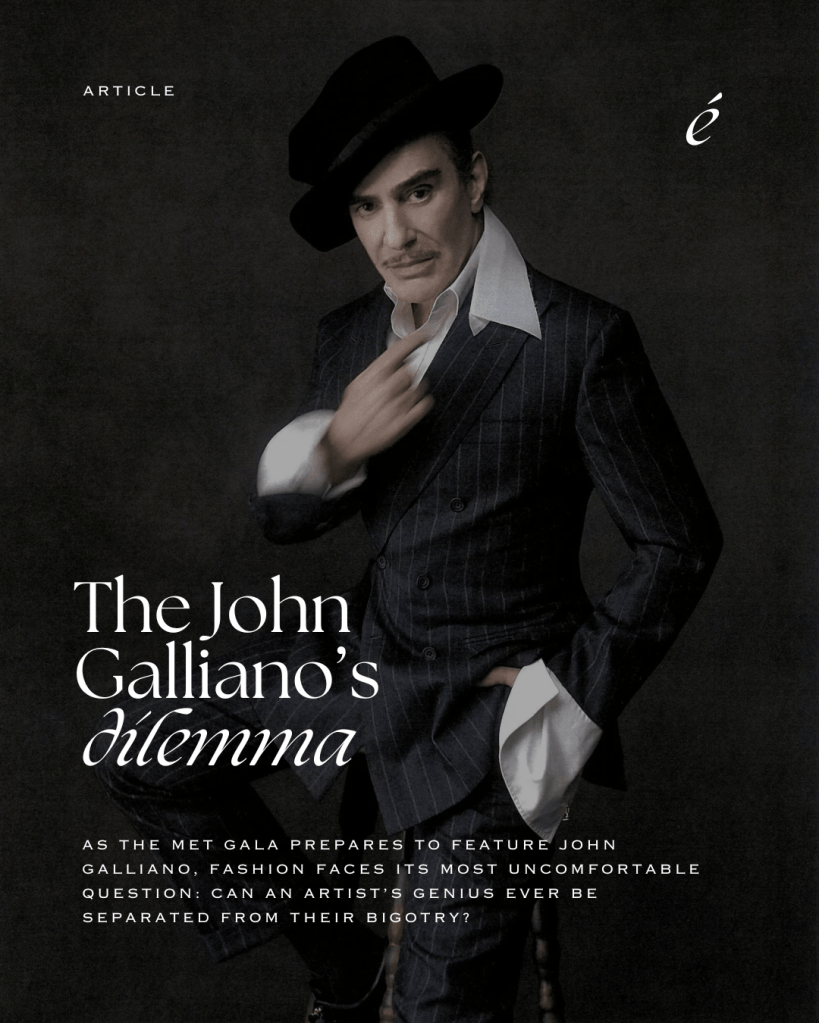
  • JOHN GALLIANO’S CONTROVERSY AND THE MET GALA:


    BY CHIARA DI LEO

    Can we separate the artist from the art?

    Photo: Szilveszter Mako


    How many artists do we know are controversial? Take Pablo Picasso, for example, or in late 2022, the controversy surrounding the designer Demna, who came under fire after Balenciaga released a campaign under his tenure featuring children holding teddy bears in BDSM-style gear. Now, however, the spotlight is on the Galliano controversy. Galliano is a famous designer who, after making racist comments, was fired from Dior, a position he had held for 15 years. Today, he is set to be the subject of the upcoming Met Gala.

    The question that arises is: Can we separate his ethics or even his person from his art for a Met Gala exhibition? Is it unethical and a major wrongdoing? To answer this, we need to unwrap Galliano’s career and his actions.
    Galliano himself stated that in the early 2010s he was overwhelmed as he produced as many as 32 collections a year. He affirmed that he deeply relied on a cocktail of drugs, often non-prescribed, while struggling with suicidal thoughts. In 2011, while sitting at a Parisian bar, the designer insulted a woman, calling her an “ugly Jewish face,” and told another man, “F***ing Asian bastard, I will kill you.” Galliano was soon arrested and had to face a lot of negative press. Initially, he pledged to sue for defamation. But, unfortunately, this was not the end; a few months later, he made several anti-Semitic comments.
    Therefore, he was promptly fired from Dior, where he had been working for more than 15 years. He was also publicly condemned by many collaborators, such as Natalie Portman, who was the face of a Dior fragrance. After these negative rants, he spent two months in rehab in Arizona before returning to Paris to face criminal charges. He was fined and convicted of “public insults for reasons of religion, race, or ethnicity”. At the time, Galliano’s fall seemed absolute: the UK’s Guardian newspaper declared it “doubtful” that he would ever redeem himself. Only a few years later, in 2014, Galliano came back to work and to the public eye: he was hired by Maison Margiela as its creative director. But what about those atrocious insults? Were they forgotten?


    Earlier, in 2013, Galliano had received absolution from at least one major Jewish group. Abe Foxman of the Anti-Defamation League stated that Galliano had “worked arduously to change his worldview and dedicated a significant amount of time to researching, reading, and learning about the evils of anti-Semitism and bigotry.” In 2023, the designer spoke further about his addiction and how it had unravelled his life.
    After that, he collaborated in the production of his documentary High & Low – John Galliano, where he further explains this deep and dark chapter of his life. At the moment, he is again the centre of attention, as he is set to be the focus of a major exhibition at the Metropolitan Museum of Art in New York. Even if some believe he has worked to earn forgiveness, this remains a difficult topic for the Met Gala institution to handle. How will the Met address such a controversial designer?
    The Met’s response is to directly address the issue: the Museum’s Costume Institute, which oversees the annual exhibition and gala, insists it is not shying away from Galliano’s past anti-Semitic and racist comments. As a matter of fact, the show is named “John Galliano: Horizons,” and, as a press release from the museum stated, it will “consider how artistic achievement should be understood alongside ethical accountability.”


    Andrew Bolton, the Met curator, affirms that the exhibition “considers both how Galliano has remapped the world through fashion and how his conduct, its consequences, and changing cultural values have reshaped our understanding of his work.” However, in order to fully take accountability, according to The New York Times, planning for the Met exhibition has included meetings with rabbis and Jewish leaders in order to engage with the community most hurt by the designer’s comments.
    The choice of this very controversial designer is also to be found in the potent influence of Anna Wintour, whose friendship with the designer dates back to the 1990s. “It isn’t often that you meet a great designer,” Wintour said in the documentary High & Low. “But when you saw what John was doing, you realised that he was one of them.” Wintour also emphasised that “the exhibition won’t shy away from any of the darkness in John’s past. It’s part of what has shaped him.” However, according to CNN, they reached out to both Galliano’s and Wintour’s offices, but neither provided further comment. Ultimately, the Met Gala and its organisers are not trying to erase Galliano’s past, but rather to contextualise it. Whether one can truly separate the artist from the art remains a deeply personal question, and it is your choice whether to agree with the Met’s decision. By bringing a figure as complex and controversial as Galliano back into the spotlight, the exhibition forces us to confront an uncomfortable truth: masterpiece and flaw can coexist in the same hands. The fashion world moves fast and, most of the time, forgets easily, but it is our choice to set a boundary. Karl Lagerfeld was also very controversial, so it is not the first time the Met has challenged us with such a decision. Only time will tell how the general public and the fashion world will react, and we will soon see how this bold decision unfolds in May 2027, when the next Met exhibition will happen.

  • WHEN CULTURE BECOMES A TREND


    BY GIULIA LIU

    Everyone has probably seen Adidas’ Tang Suit at least once: a jacket that combines the classic design of an Adidas tracksuit with elements inspired by traditional Chinese clothing, particularly the tángzhuāng. The jacket was officially presented during Shanghai Fashion Week towards the end of 2025 as a piece dedicated to Chinese Lunar New Year, and from there it began to gain popularity, mostly through social media.

    The jacket was noticed, shared and worn by influencers and content creators. Within just a few months of the Adidas Tang Suit’s launch, enthusiastic reactions and growing attention towards the jacket led it to become a genuine fashion phenomenon and an object of desire. Its aesthetic was perceived as new, interesting, different, even “exotic”.

    Emerging brands and, inevitably, fast fashion, have picked up on its distinctive features. 

    Today, walking through stores, we can find standing collars (lìlǐng), diagonal closures (dàjīn), and knotted buttons (pánkòu) reinterpreted in tops, shirts, cardigans, blazers and contemporary dresses. These pieces are presented to consumers under labels such as “Asian style”, “Oriental style”, or simply “blouse”. Moreover, elements associated with Chinese clothing are sometimes attributed to entirely different cultures. A particularly paradoxical example is that of qípáo-inspired pieces presented as Japanese “Geisha style”: two distinct traditions reduced to the same vague and undifferentiated image of the “Orient”.

    But what do we mean by “the Orient”? The term is historically Eurocentric, grouping vastly different realities under a single category constructed from a Western perspective. 

    Trends, by their very nature, are temporary. And when this one is over, what will remain?

    It is a question we rarely ask ourselves when something becomes fashionable. We are accustomed to thinking of trends as a harmless and temporary phenomenon that suddenly appear, only to be replaced just as quickly. A garment such as the qípáo exists independently of contemporary Western fashion. It has a history and cultural significance; it was already there long before it became a trend. If, once this trend has passed, it is simply remembered as “that Asian style that was fashionable in 2026”, then it means that the culture will have been consumed without being understood, and perhaps without being remembered.

    The solution is not to ask fashion to stop looking to other cultures, because drawing inspiration from them is not, in itself, a problem. Fashion and art have always been shaped by cultural exchanges, influences and reinterpretations. Expecting every designer to work exclusively within the boundaries of their own culture would be contrary to the very nature of creativity.

    Wearing a qípáo does not automatically make someone a cultural appropriator, just as an artist can draw inspiration from a tradition that does not belong to their own culture. The question, rather, is how that inspiration is approached.

    The problem arises when, in the attempt to turn a cultural element into a trend, its history, meaning and even its name are erased. When a tradition is presented as a generic aesthetic and, above all, when culture is used as a resource to sell a product.

    Perhaps the simplest solution is also the most obvious one: when we take something from another culture, we should not erase where it came from.

  • THE MET GALA’S SYNOPSIS


    BY CHIARA DI LEO

    For those who might need a quick catch-up, here is a summary of what you need to know about this iconic event and its most recent edition.

    Julian Hamilton – Getty images

    Once a year, New York City becomes the centre of the fashion world as all eyes lock onto a single event: the Met Gala. Also known as the “Oscars of the Fashion world”, the Met Gala is more than just a red carpet; it is a charity event and fundraiser that directly supports the Metropolitan Museum of Art’s Costume Institute. If you are wondering whether it actually raises significant funds or it’s just a little yearly reunion for an elite of celebrities, the answer is a resounding yes; the latest Met Gala raised a record-breaking $42 million. Every year, a specific theme is selected, which heavily influences the dress code. The latest theme? “Costume Art,” with the dress code defined as “Fashion is Art.” For the guests, months of work go into planning each look, collaborating with designers and glam squads to interpret the exhibition theme. The latest edition inaugurated the Met’s new, nearly 12,000-square-foot Condé M. Nast Galleries. For those who didn’t quite catch it from the name, the Met Gala takes place every year at the Metropolitan Museum of Art.

    The exhibition explores various depictions of the dressed body across the Met’s curatorial departments, pairing garments with diverse art objects spanning some 5,000 years. The objects featured in “Costume Art” are organised into a series of thematic body types that range from the “Classical Body”, both of which is well-represented within the museum’s existing collection, and broadly in a lot of museums, to the “Pregnant Body” and the “Ageing Body,” which have historically been overlooked. At this point, you are familiar with the basics and the core theme, which is crucial, as it dictates the entire atmosphere of the evening; you might be curious about the actual experience.

    Each year, the Met Gala welcomes a few celebrity co-chairs as hosts for the event. This year, the co-chairs were Beyoncé, Venus Williams, and Nicole Kidman, alongside Anna Wintour. The question remains: What really happens inside? Interestingly, the details are kept very secretively, as guests are required to follow a strict no-phone (and no social media) rule once they cross the threshold. That naturally makes this event very exclusive and looked at. However, the evening typically flows from cocktails to a formal dinner, capped off by a performance from a high-profile artist. And, naturally, the attendees can visit the exhibition. For the latest edition, that spotlight belonged to Sabrina Carpenter and Madonna.

    The décor is always a masterpiece in its own right; for 2026, the event designer Raúl Àvila drew inspiration from Northern Italian gardens, featuring fruit-adorned tablescapes and elegant striped linens. Despite the intense privacy, the guest list remains the most coveted in the world, usually limited to around 450 exclusive attendees. Outside the event, however, the atmosphere is completely different. Crowds of fans and countless paparazzi gather for hours, hoping to catch a glimpse of their favourite celebrities as they arrive at one of the most famous fashion shows. And for 2027? What’s awaited? According to @vogue magazine, the Met Costume Institute just announced that it will dedicate its 2027 spring show and gala to the work of designer John Galliano. John Galliano is a British fashion designer widely regarded as one of the most brilliant and theatrical forces in modern luxury fashion. He is best known for his spectacular, historically romantic tenure as the creative director of Christian Dior from 1996 to 2011. Following a public downfall and exile due to racist remarks made during a struggle with addiction, he underwent extensive rehabilitation and made a successful comeback. He currently serves as the creative director of Maison Margiela, where his critically acclaimed Spring/Summer 2024 Artisanal collection cemented his status as a master of avant-garde haute couture.

  • CARVED IN THREAD:


    BY CHIARA DI LEO

    Rahul Mishra’s 2026 collection

    Rahul Mishra

    As Rahul Mishra himself stated: “My work thrives on nowness, what feels relevant today, yet it is grounded in tradition. We start with centuries-old techniques and give them space to evolve. A 200-year-old embroidery may become a silhouette that feels like the future. People call it a break from tradition; I see it as expansion. We honour every stitch’s lineage but refuse to let it stand still. By seeking newness from within history, we keep tradition alive and dynamic for a global audience.” These words perfectly capture his design philosophy and set the stage for his latest creation, “Devi, the Eternal Muse,” his Fall 2026 couture collection.

    Based in New Delhi, Mishra recently emerged as a world-renowned couturier, most notably becoming the first Indian designer invited to show at Paris Haute Couture Week. His collection is deeply connected to his heritage, and it is evident how antique Indian sculpture influenced all the dresses presented on the runway. This collection was born from a deep and conscious reflection on sculpture: just as Michelangelo did many centuries later, ancient Indian artistic and spiritual philosophy viewed sculpting as a reductive act, where you remove excess stone to free the subject. Long before the Italian Renaissance, inside sacred temples, artisans used to transform blocks of sandstone, granite, and basalt into eternal muses, devis, and celestial dancers. We can surely affirm that those artisans, and now Mishra, and specifically their works, are enduring repositories of memory. Mishra is inspired by the sculptures located in the temples of his native country, but views his art more through “accumulation”, threads that, embroidered one with another, build a three-dimensional figure.

    Throughout his life, he has also been very close to the feminine side of his family and deeply connected to the concept of Shakti (the feminine force), which he wants to represent through his work. These beautiful works of art, after their debut in Paris, were presented triumphantly at India Couture Week 2026. Thanks to reports from Asian News International, we can further understand these masterpieces. The garments are made with a famous Rahul Mishra embroidery technique called ektaarka. It is this micro-embroidery that makes the dresses three-dimensional and gives them a sculpted stone texture. “Carved in thread” is the expression Mishra uses to describe his work. Blogs like Reet Lifestyle, which have covered the designer, raise an interesting question: Is there a line between a dress and an art costume in haute couture? The answer could be a resounding no, as Mishra’s couture is museum-worthy, and the dresses presented on both runways are wearable masterpieces.

  • THE MOLLY TEA VS LOUIS VUITTON CONTROVERSY:


    BY GIULIA LIU

    Can big luxury brands survive without Chinese consumers?

    In the contemporary luxury landscape, the most intriguing battles are no longer fought solely on the runways, but also within the world of branding. It is here that a graphic detail, a monogram or a colour palette can transform into a symbol of identity, prestige and, at times, controversy.

    This is precisely the case of the recent dispute between the luxury giant Louis Vuitton and the Chinese tea chain Molly Tea. 

    Molly Tea is a brand founded in 2020 that initially used its name in Chinese characters accompanied by a simple drawing of a jasmine bud, a visual identity closely aligned with the positioning of a tea chain specialising in floral infusions.

    Later, in the second half of 2024, the company launched a major rebranding campaign: the jasmine bud was replaced by a black geometric four-petal logo, which was applied across store signs, cups, shopping bags, packaging and the website. It was this new logo that drew Louis Vuitton’s attention, leading the French luxury house to initiate legal action in early 2026.

    Eventually, the Suzhou Intermediate People’s Court ruled that the Chinese beverage chain Molly Tea infringed seven Louis Vuitton trademarks featuring the distinctive four-petal floral motif registered in the late 19th century. The court also ordered the company to pay damages of 10.3 million yuan, equivalent to 1.5 million US dollars. This ruling took into account the fact that Molly Tea had previously attempted to register 17 similar trademarks for the logo, all of which were rejected by the China National Intellectual Property Administration except for the only one that didn’t have a four-petal flower, leading to the conclusion that Molly Tea was aware of the fact that its new logo could cause some friction with other brands. The Chinese tea chain has already announced that it will appeal, meaning that the ruling is not yet enforceable. 

    However, in recent months, the dispute has gained significant media attention, particularly due to the reaction of the Chinese public. On social media, many users considered the ruling unfair, tracing the four-petal floral motif back to traditional Chinese decorative elements, especially the baoxiang hua, an ornamental pattern dating back to the Tang dynasty and inspired by the lotus flower and peony. Images soon began circulating online comparing Louis Vuitton’s monogram with the decorations of a Tang-dynasty rosewood pipa and with the four-petal lattice windows of ancient Chinese buildings.

    The hashtag dedicated to the dispute quickly entered Weibo’s trending topics, while another hashtag claiming that “Molly Tea lost the lawsuit but won over the public” surpassed 400 million views and tens of thousands of comments, as the BBC declares.

    The dispute has also highlighted a broader sense of frustration among the Chinese public, with many people accusing international luxury brands of borrowing elements from other cultures without properly acknowledging their origins.

    While Molly Tea has officially revamped its logo after the court ruling, Chinese people are claiming that legal ownership and cultural ownership are not the same. Right now, the Chinese community is boycotting LV, even using its bags as a “carrying-toilet- paper bag” because the brand’s signature floral pattern resembles traditional Chinese ceramic wall tiles once common in public pit toilets. This recent controversy raises a broader question: can consumer boycotts truly influence major luxury brands? Well, boycotts are moderately effective in inflicting short-term financial and reputational damage on targeted brands, but they usually have a weaker impact in the long term. However, when a market accounts for more than one-third of global luxury spending, as Chinese consumers do, the consequences can be significant. The 2018 boycott against Dolce & Gabbana says it all: it stands as the most devastating and long-lasting example of a Chinese consumer boycott against luxury brands. Unlike many boycotts that blow over in a few months, D&G suffered severe, multi-year financial losses and was effectively erased from the mainstream Chinese luxury market for years, with some reports indicating a 98% drop in sales in mainland China.

  • CARVED IN ELEGANCE


    BY DAYANA KAZANGAPOVA

    The Cultural Legacy and Modern Allure of Marble.

    From the temples of antiquity to the hushed white cube of the modern gallery, marble has stayed architecture’s material of choice for saying two things at once: permanence and power. No other stone has managed to carry both with quite the same conviction.

    Calling it “a stone” undersells it. Marble behaves more like trapped light, cool one moment, glowing the next, changing its temperament with the hour of day or the angle you catch it at. Every civilisation that built with it seemed to know this instinctively. They weren’t just using a durable material; they were handing it a job: to speak for them long after they were gone, to say, in a substance built to outlast empires, that something here was meant to last.

    This isn’t a survey of a rock. It’s a look at how the world’s most demanding cultures decided to let that rock talk.

    A Geography Written in Stone

    Marble isn’t a single material; it’s a bloodline, and it tells a different story depending on where it was quarried. Each region has bent the stone into its own dialect: its own veining, its own colour, its own way of catching light.

    Carrara and Calacatta, Italy, Tuscany’s white gold. Above Carrara, in the same quarries where Michelangelo once picked out blocks for the Pietà, the marble comes out almost impossibly white and fine-grained, faintly lit from within, as if it had simply decided imperfection wasn’t an option. Its cousin Calacatta takes that whiteness and runs it through with bold, gold veining, a marble that doesn’t just sit in a room; it announces itself.

    Afyon and Marmara, Turkey, the quiet marbles. Afyon marble is a softer white, veined faintly in grey, closer to a whisper than a statement. Its more storied relative comes from the Sea of Marmara, quarried since antiquity and shipped across the Byzantine and Ottoman worlds, the stone behind Constantinople’s great domes and columns, Hagia Sophia included. Afyon settles quietly into a room. Marmara, for centuries, was the material of a capital.

    Thassos, Greece, the snow-white marble. On the island of Thassos, the stone turns almost celestial: a white so pure and reflective that ancient sculptors ranked it above nearly everything else for the way it holds and throws back light. Carrara feels architectural. Thassos feels closer to sacred.

    Emperador, Spain, the dramatic one. Here the register flips entirely, deep umber fields instead of white. It’s long been the go-to in high-end interiors for the instant sense of warmth and gravity it lends a room, a kind of quiet wealth you feel before you name it.

    The material itself never changes. What separates these traditions, what turns marble from a building material into a civilisational statement, is the discipline each culture applied to what the stone was allowed to say once it left the ground.

    Soloist or Ensemble: The West and the East

    The stone stayed the same. What changed was the room built around it.

    The soloist. In the classical tradition, Roman forums, the Renaissance, and the minimalist interiors of today, marble was rarely asked to share the stage. A column stood alone as a column. A statue held a room through its silhouette alone, not its surroundings. That instinct hasn’t gone anywhere: in a contemporary kitchen or a private gallery, one slab of marble, veining left fully exposed, can still make the entire argument for the space around it. Marble as monolith. Marble as protagonist. The one voice the room exists to amplify.

    The ensemble. Across the architectural traditions of Anatolia, Egypt, and Central Asia, Persianate, Timurid, Ottoman, marble was never the soloist. It was one voice among many: glazed tile, intricate mosaic, the flowing geometry of calligraphy, each calibrated against the others. No single material was meant to dominate. The effect came not from one loud voice but from the accumulated weight of many, carefully balanced. Marble, in this tradition, isn’t the protagonist; it’s the surface that lets everything else resonate.

    Same stone, two civilisations, two entirely different ideas of what luxury even means.

    From Facade to Furniture

    For most of its history, marble’s grandeur was tied to scale. It crowned facades, filled cathedrals, stood in public squares built to outlive whoever commissioned them. To own marble was, in a sense, to own architecture.

    That’s shifted. Over the last few decades, marble has made a quiet migration, down from the colonnade to the coffee table, out of the cathedral nave and into the kitchen island. It no longer needs a building to justify its presence; it’s become a collectable object in its own right.

    None of this has cost the material its authority.

    A dining table cut from Calacatta or Emperador isn’t just furniture anymore; collectors treat it the way they’d treat a painting, prized precisely because its pattern can never be repeated. The market has taken that idea literally: at Design Miami 2023, Ateliers Courbet sold Archetype I Marble, a hand-carved Belgian marble table by designer Raphael Navot, bought not as furniture but as a limited-edition object. A decade before that, Rick Owens had already claimed this ground with his 3 Prong Bench, black marble benches shown at MOCA Los Angeles in an exhibition that gave stone furniture the same gravity usually reserved for sculpture.

    Photo credit: Raphael Navot Archetype | Ateliers Courbet

    Further east, Beirut-based designer Nada Debs has built an entire practice on the same premise. Her marble “Pebble” table, carved into soft, rounded curves, carries that same ornamental sensibility, proof that the region’s old instinct toward harmony and craft hasn’t lost an ounce of force in the modern showroom. In every one of these pieces, the marble isn’t hidden behind function. It’s the reason the object exists.

    Seen this way, the modern interior hasn’t shrunk marble’s grandeur at all. It’s simply relocated it from the scale of the monument to the scale of the object, without asking the stone to give up any of the weight it has always carried.

  • THE COPYCAT SECRET SOCIETY


    BY CHRISTINE AMEFIAM

    Conform or Be Condemned: The High Cost of Standing Out

    Cringe, that’s the word they use when you stand out too much. Weird, that’s the adjective they add to unique personalities. Iconic, that’s the word they employ when they wear your identity like a trend!

    In a World of Clones, Being Different Makes You the Villain, but if you are a nice-looking villain, they will turn you into a template.

    Welcome to the Age of Copy-Paste Humans. No identity, no originality, no selfhood, no distinction.

    Every year, a new aesthetic appears, a new fashion trend that people rush to follow. Not long ago, everyone was obsessed with the “clean girl” aesthetic; now the shift seems to be toward bolder, more dramatic and expressive styles. Some people are even talking about bringing back grunge makeup. Will it actually happen? Probably.

    The same thing happens with music. Whenever a song goes viral, everyone uses that exact song over and over again. Take TikTok as an example: if you scroll through ten videos, at least eight of them will have the same melody. The reason is simple: people want views, they want to go viral, they want popularity.

    Even classical music is going through this cycle. Many people are only now discovering how relaxing it can be. If one person says that classical music pairs well with rap and the idea goes viral, suddenly everyone starts repeating the same opinion.

    This pattern doesn’t apply only to fashion and music, but also to language. Words like narcissism and accountability constantly trend online. First it was narcissism: people began using the word without really understanding its meaning. If someone seems self-absorbed, they are immediately labelled a narcissist. Now the trending word is accountability. Aren’t there other ways to express the same idea? Of course there are; responsibility, for example, but it sounds less sophisticated. So people choose the word that makes them appear more intelligent. It becomes a kind of performative intellectualism.

    So why not develop our own personalities instead? Having similarities with others is natural, but our differences are what make us unique, and lately, it feels like we are losing that. Sometimes it seems as if we all look the same, like the plastic Barbie dolls I used to play with when I was five: identical, polished, but lifeless.

    Why do we do this? The simplest answer is that we want to be liked. We want to be loved. We want to belong and to be accepted by others. It’s not just about presenting ourselves for the male gaze anymore; it’s about being appealing to everyone, an “everybody gaze.”

order, clarity, and elegance

JEUDI éCHOS

Magazine