
BY DAYANA KAZANGAPOVA
The Cultural Legacy and Modern Allure of Marble.
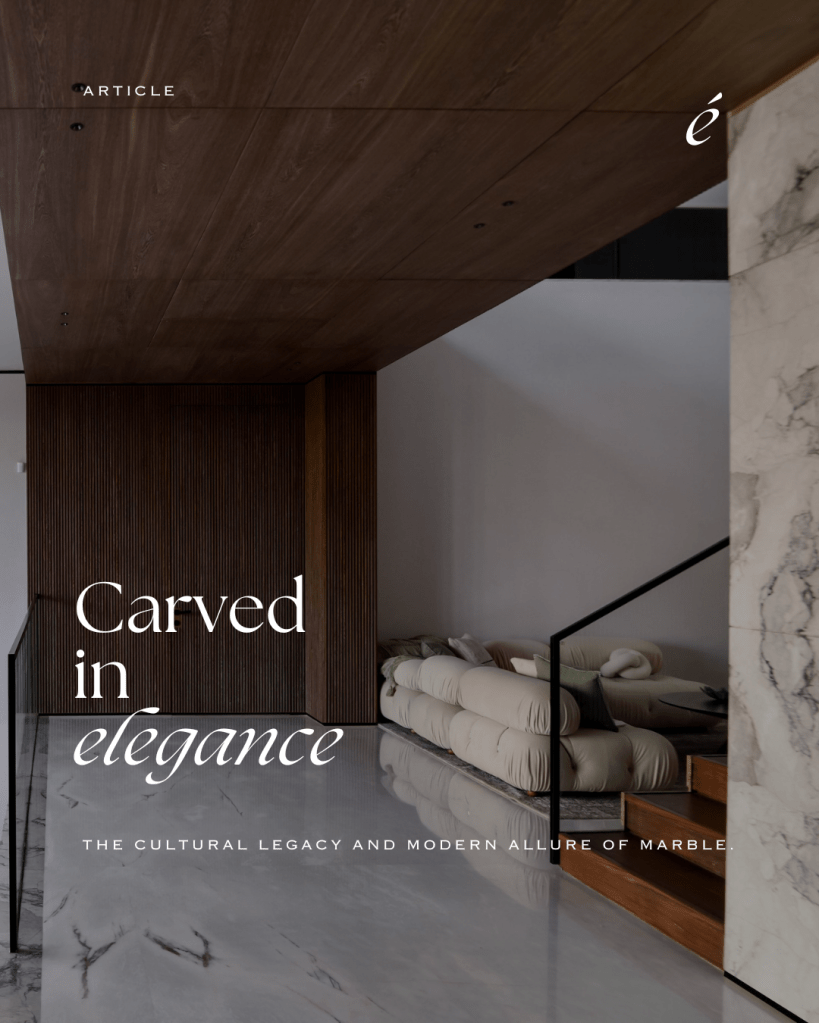
From the temples of antiquity to the hushed white cube of the modern gallery, marble has stayed architecture’s material of choice for saying two things at once: permanence and power. No other stone has managed to carry both with quite the same conviction.
Calling it “a stone” undersells it. Marble behaves more like trapped light, cool one moment, glowing the next, changing its temperament with the hour of day or the angle you catch it at. Every civilisation that built with it seemed to know this instinctively. They weren’t just using a durable material; they were handing it a job: to speak for them long after they were gone, to say, in a substance built to outlast empires, that something here was meant to last.
This isn’t a survey of a rock. It’s a look at how the world’s most demanding cultures decided to let that rock talk.
A Geography Written in Stone
Marble isn’t a single material; it’s a bloodline, and it tells a different story depending on where it was quarried. Each region has bent the stone into its own dialect: its own veining, its own colour, its own way of catching light.
Carrara and Calacatta, Italy, Tuscany’s white gold. Above Carrara, in the same quarries where Michelangelo once picked out blocks for the Pietà, the marble comes out almost impossibly white and fine-grained, faintly lit from within, as if it had simply decided imperfection wasn’t an option. Its cousin Calacatta takes that whiteness and runs it through with bold, gold veining, a marble that doesn’t just sit in a room; it announces itself.
Afyon and Marmara, Turkey, the quiet marbles. Afyon marble is a softer white, veined faintly in grey, closer to a whisper than a statement. Its more storied relative comes from the Sea of Marmara, quarried since antiquity and shipped across the Byzantine and Ottoman worlds, the stone behind Constantinople’s great domes and columns, Hagia Sophia included. Afyon settles quietly into a room. Marmara, for centuries, was the material of a capital.
Thassos, Greece, the snow-white marble. On the island of Thassos, the stone turns almost celestial: a white so pure and reflective that ancient sculptors ranked it above nearly everything else for the way it holds and throws back light. Carrara feels architectural. Thassos feels closer to sacred.
Emperador, Spain, the dramatic one. Here the register flips entirely, deep umber fields instead of white. It’s long been the go-to in high-end interiors for the instant sense of warmth and gravity it lends a room, a kind of quiet wealth you feel before you name it.
The material itself never changes. What separates these traditions, what turns marble from a building material into a civilisational statement, is the discipline each culture applied to what the stone was allowed to say once it left the ground.
Soloist or Ensemble: The West and the East
The stone stayed the same. What changed was the room built around it.
The soloist. In the classical tradition, Roman forums, the Renaissance, and the minimalist interiors of today, marble was rarely asked to share the stage. A column stood alone as a column. A statue held a room through its silhouette alone, not its surroundings. That instinct hasn’t gone anywhere: in a contemporary kitchen or a private gallery, one slab of marble, veining left fully exposed, can still make the entire argument for the space around it. Marble as monolith. Marble as protagonist. The one voice the room exists to amplify.
The ensemble. Across the architectural traditions of Anatolia, Egypt, and Central Asia, Persianate, Timurid, Ottoman, marble was never the soloist. It was one voice among many: glazed tile, intricate mosaic, the flowing geometry of calligraphy, each calibrated against the others. No single material was meant to dominate. The effect came not from one loud voice but from the accumulated weight of many, carefully balanced. Marble, in this tradition, isn’t the protagonist; it’s the surface that lets everything else resonate.
Same stone, two civilisations, two entirely different ideas of what luxury even means.
From Facade to Furniture
For most of its history, marble’s grandeur was tied to scale. It crowned facades, filled cathedrals, stood in public squares built to outlive whoever commissioned them. To own marble was, in a sense, to own architecture.
That’s shifted. Over the last few decades, marble has made a quiet migration, down from the colonnade to the coffee table, out of the cathedral nave and into the kitchen island. It no longer needs a building to justify its presence; it’s become a collectable object in its own right.
None of this has cost the material its authority.
A dining table cut from Calacatta or Emperador isn’t just furniture anymore; collectors treat it the way they’d treat a painting, prized precisely because its pattern can never be repeated. The market has taken that idea literally: at Design Miami 2023, Ateliers Courbet sold Archetype I Marble, a hand-carved Belgian marble table by designer Raphael Navot, bought not as furniture but as a limited-edition object. A decade before that, Rick Owens had already claimed this ground with his 3 Prong Bench, black marble benches shown at MOCA Los Angeles in an exhibition that gave stone furniture the same gravity usually reserved for sculpture.
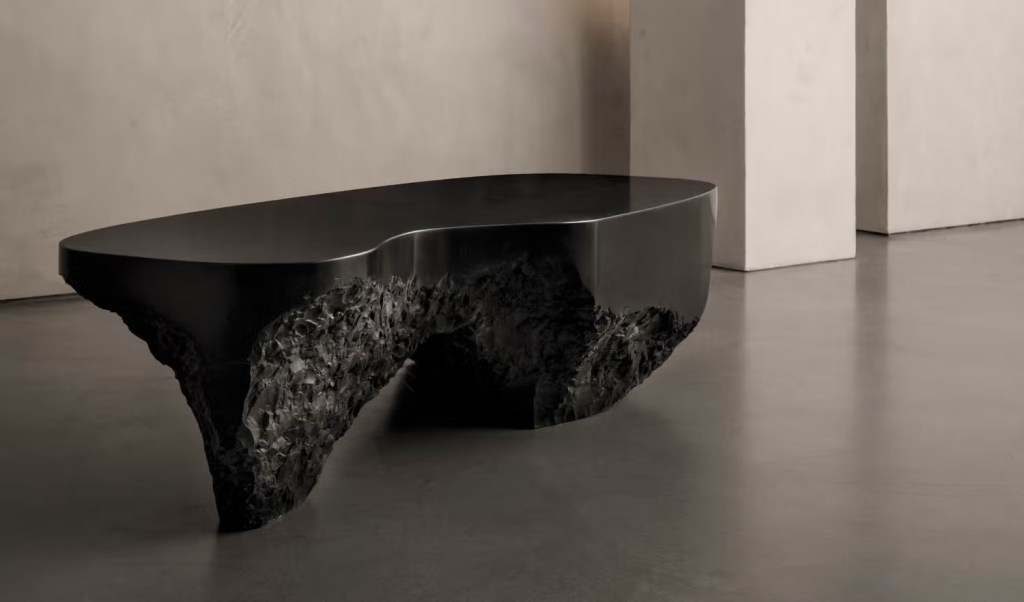
Photo credit: Raphael Navot Archetype | Ateliers Courbet
Further east, Beirut-based designer Nada Debs has built an entire practice on the same premise. Her marble “Pebble” table, carved into soft, rounded curves, carries that same ornamental sensibility, proof that the region’s old instinct toward harmony and craft hasn’t lost an ounce of force in the modern showroom. In every one of these pieces, the marble isn’t hidden behind function. It’s the reason the object exists.
Seen this way, the modern interior hasn’t shrunk marble’s grandeur at all. It’s simply relocated it from the scale of the monument to the scale of the object, without asking the stone to give up any of the weight it has always carried.

Leave a comment