
BY GIULIA LIU
Can big luxury brands survive without Chinese consumers?
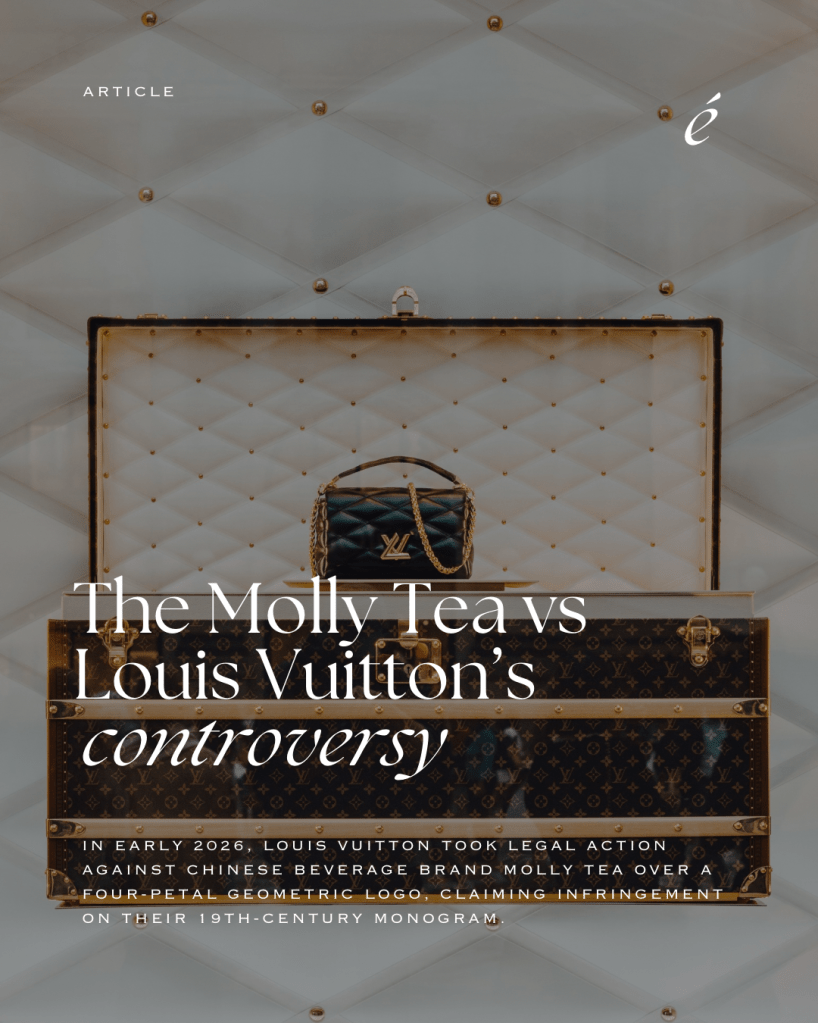
In the contemporary luxury landscape, the most intriguing battles are no longer fought solely on the runways, but also within the world of branding. It is here that a graphic detail, a monogram or a colour palette can transform into a symbol of identity, prestige and, at times, controversy.
This is precisely the case of the recent dispute between the luxury giant Louis Vuitton and the Chinese tea chain Molly Tea.
Molly Tea is a brand founded in 2020 that initially used its name in Chinese characters accompanied by a simple drawing of a jasmine bud, a visual identity closely aligned with the positioning of a tea chain specialising in floral infusions.
Later, in the second half of 2024, the company launched a major rebranding campaign: the jasmine bud was replaced by a black geometric four-petal logo, which was applied across store signs, cups, shopping bags, packaging and the website. It was this new logo that drew Louis Vuitton’s attention, leading the French luxury house to initiate legal action in early 2026.
Eventually, the Suzhou Intermediate People’s Court ruled that the Chinese beverage chain Molly Tea infringed seven Louis Vuitton trademarks featuring the distinctive four-petal floral motif registered in the late 19th century. The court also ordered the company to pay damages of 10.3 million yuan, equivalent to 1.5 million US dollars. This ruling took into account the fact that Molly Tea had previously attempted to register 17 similar trademarks for the logo, all of which were rejected by the China National Intellectual Property Administration except for the only one that didn’t have a four-petal flower, leading to the conclusion that Molly Tea was aware of the fact that its new logo could cause some friction with other brands. The Chinese tea chain has already announced that it will appeal, meaning that the ruling is not yet enforceable.
However, in recent months, the dispute has gained significant media attention, particularly due to the reaction of the Chinese public. On social media, many users considered the ruling unfair, tracing the four-petal floral motif back to traditional Chinese decorative elements, especially the baoxiang hua, an ornamental pattern dating back to the Tang dynasty and inspired by the lotus flower and peony. Images soon began circulating online comparing Louis Vuitton’s monogram with the decorations of a Tang-dynasty rosewood pipa and with the four-petal lattice windows of ancient Chinese buildings.
The hashtag dedicated to the dispute quickly entered Weibo’s trending topics, while another hashtag claiming that “Molly Tea lost the lawsuit but won over the public” surpassed 400 million views and tens of thousands of comments, as the BBC declares.
The dispute has also highlighted a broader sense of frustration among the Chinese public, with many people accusing international luxury brands of borrowing elements from other cultures without properly acknowledging their origins.
While Molly Tea has officially revamped its logo after the court ruling, Chinese people are claiming that legal ownership and cultural ownership are not the same. Right now, the Chinese community is boycotting LV, even using its bags as a “carrying-toilet- paper bag” because the brand’s signature floral pattern resembles traditional Chinese ceramic wall tiles once common in public pit toilets. This recent controversy raises a broader question: can consumer boycotts truly influence major luxury brands? Well, boycotts are moderately effective in inflicting short-term financial and reputational damage on targeted brands, but they usually have a weaker impact in the long term. However, when a market accounts for more than one-third of global luxury spending, as Chinese consumers do, the consequences can be significant. The 2018 boycott against Dolce & Gabbana says it all: it stands as the most devastating and long-lasting example of a Chinese consumer boycott against luxury brands. Unlike many boycotts that blow over in a few months, D&G suffered severe, multi-year financial losses and was effectively erased from the mainstream Chinese luxury market for years, with some reports indicating a 98% drop in sales in mainland China.

Leave a comment