
BY CHIARA DI LEO
Can we separate the artist from the art?
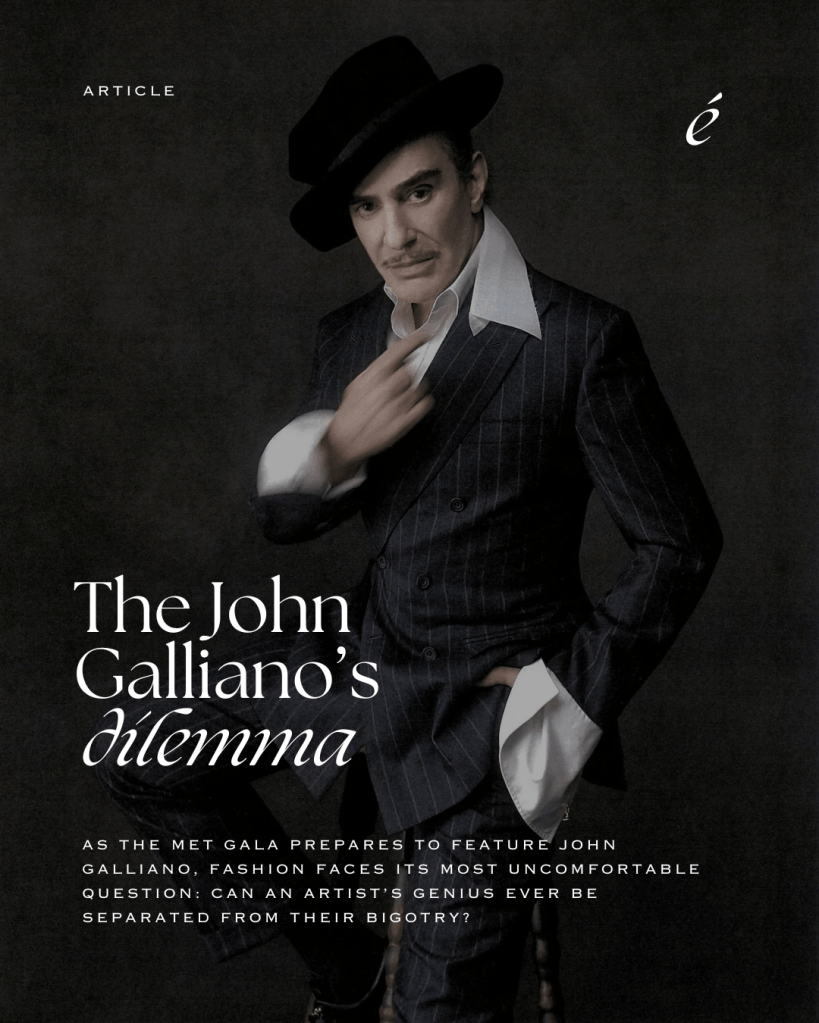
How many artists do we know are controversial? Take Pablo Picasso, for example, or in late 2022, the controversy surrounding the designer Demna, who came under fire after Balenciaga released a campaign under his tenure featuring children holding teddy bears in BDSM-style gear. Now, however, the spotlight is on the Galliano controversy. Galliano is a famous designer who, after making racist comments, was fired from Dior, a position he had held for 15 years. Today, he is set to be the subject of the upcoming Met Gala.
The question that arises is: Can we separate his ethics or even his person from his art for a Met Gala exhibition? Is it unethical and a major wrongdoing? To answer this, we need to unwrap Galliano’s career and his actions.
Galliano himself stated that in the early 2010s he was overwhelmed as he produced as many as 32 collections a year. He affirmed that he deeply relied on a cocktail of drugs, often non-prescribed, while struggling with suicidal thoughts. In 2011, while sitting at a Parisian bar, the designer insulted a woman, calling her an “ugly Jewish face,” and told another man, “F***ing Asian bastard, I will kill you.” Galliano was soon arrested and had to face a lot of negative press. Initially, he pledged to sue for defamation. But, unfortunately, this was not the end; a few months later, he made several anti-Semitic comments.
Therefore, he was promptly fired from Dior, where he had been working for more than 15 years. He was also publicly condemned by many collaborators, such as Natalie Portman, who was the face of a Dior fragrance. After these negative rants, he spent two months in rehab in Arizona before returning to Paris to face criminal charges. He was fined and convicted of “public insults for reasons of religion, race, or ethnicity”. At the time, Galliano’s fall seemed absolute: the UK’s Guardian newspaper declared it “doubtful” that he would ever redeem himself. Only a few years later, in 2014, Galliano came back to work and to the public eye: he was hired by Maison Margiela as its creative director. But what about those atrocious insults? Were they forgotten?
Earlier, in 2013, Galliano had received absolution from at least one major Jewish group. Abe Foxman of the Anti-Defamation League stated that Galliano had “worked arduously to change his worldview and dedicated a significant amount of time to researching, reading, and learning about the evils of anti-Semitism and bigotry.” In 2023, the designer spoke further about his addiction and how it had unravelled his life.
After that, he collaborated in the production of his documentary High & Low – John Galliano, where he further explains this deep and dark chapter of his life. At the moment, he is again the centre of attention, as he is set to be the focus of a major exhibition at the Metropolitan Museum of Art in New York. Even if some believe he has worked to earn forgiveness, this remains a difficult topic for the Met Gala institution to handle. How will the Met address such a controversial designer?
The Met’s response is to directly address the issue: the Museum’s Costume Institute, which oversees the annual exhibition and gala, insists it is not shying away from Galliano’s past anti-Semitic and racist comments. As a matter of fact, the show is named “John Galliano: Horizons,” and, as a press release from the museum stated, it will “consider how artistic achievement should be understood alongside ethical accountability.”
Andrew Bolton, the Met curator, affirms that the exhibition “considers both how Galliano has remapped the world through fashion and how his conduct, its consequences, and changing cultural values have reshaped our understanding of his work.” However, in order to fully take accountability, according to The New York Times, planning for the Met exhibition has included meetings with rabbis and Jewish leaders in order to engage with the community most hurt by the designer’s comments.
The choice of this very controversial designer is also to be found in the potent influence of Anna Wintour, whose friendship with the designer dates back to the 1990s. “It isn’t often that you meet a great designer,” Wintour said in the documentary High & Low. “But when you saw what John was doing, you realised that he was one of them.” Wintour also emphasised that “the exhibition won’t shy away from any of the darkness in John’s past. It’s part of what has shaped him.” However, according to CNN, they reached out to both Galliano’s and Wintour’s offices, but neither provided further comment. Ultimately, the Met Gala and its organisers are not trying to erase Galliano’s past, but rather to contextualise it. Whether one can truly separate the artist from the art remains a deeply personal question, and it is your choice whether to agree with the Met’s decision. By bringing a figure as complex and controversial as Galliano back into the spotlight, the exhibition forces us to confront an uncomfortable truth: masterpiece and flaw can coexist in the same hands. The fashion world moves fast and, most of the time, forgets easily, but it is our choice to set a boundary. Karl Lagerfeld was also very controversial, so it is not the first time the Met has challenged us with such a decision. Only time will tell how the general public and the fashion world will react, and we will soon see how this bold decision unfolds in May 2027, when the next Met exhibition will happen.

Leave a comment